· Concrete & Foundations
How Much Mortar for 1,000 Bricks or Blocks
A single leaf wall of 1000 standard metric bricks holds about 0.297 m³ (10.5 cu ft) of mortar. This guide gives the formula, a worked example in metric with imperial equivalents, the wastage allowance most estimates get wrong, and the cement and sand split for a 1:4 mix.
A thousand standard bricks take about 0.297 m³ (10.5 cu ft) of mortar into their joints. That is roughly three and a half builder's barrows, and appreciably more sand than a first order usually allows for.
Come up short and the gang stands about waiting for a delivery. Order long and you have paid to store bagged cement that keeps for a few months in a dry lock-up and rather less in a damp one. Working out how much mortar for 1000 bricks is needed takes two unit dimensions and a joint thickness, and the mortar calculator runs the arithmetic in one pass.
What follows is the formula, a worked example in metric with imperial equivalents, and the assumptions that most often send an order wrong.
What the mortar quantity actually measures
Mortar is a binder, sand and water. The binder is cement on its own, cement with hydrated lime, or a proprietary masonry cement that already carries the lime and air entrainer. Site mixes in Britain and Australia often use cement, sand and a liquid plasticiser instead. The proportions differ by region and by specification; the geometry does not.
The quantity needed for a run of brickwork is the total volume of the horizontal bed joints plus the vertical ones. Those verticals are perpends in Britain and head joints in North America, where the wet material itself is usually just called mud. It is measured in cubic metres, or in litres on small jobs, and in cubic feet or cubic yards where imperial units govern.
The number is a volume of empty space rather than a property of the brick. Unit size, joint thickness and wall thickness set it. Nothing else does.
Why the figure matters on site
Mortar arrives as two or three separate materials: cement in bags, sand by the tonne, bulk bag or cubic yard, lime in bags again. None of them is convenient to top up halfway through a lift. Ready-mixed lime:sand delivered loose, or silo mortar, shifts the problem rather than removing it.
Running short does not ruin brickwork in the way a stalled concrete pour does. Masonry is racked back and restarted every day of the week. The cost is quieter: a batch left standing on the board while someone fetches another bag.
Knocking that batch up again with water lost to evaporation is accepted practice, because bond strength suffers more from a stiff dry mix than from the small loss of compressive strength retempering causes. The failure is using mortar that has actually begun to set, and a stalled delivery is what pushes a batch to that point.
The core insight: mortar volume tracks the number of joints, not the volume of masonry. A block wall therefore takes far less mortar per square metre than a brick wall covering the same face area, even though each individual block swallows more.
How the mortar quantity is calculated
Every unit occupies a nominal space slightly larger than itself. Add one joint thickness to the length and one to the height, then multiply by the wall thickness. That gives the block of wall each brick claims. Subtract the true unit volume, and what remains is mortar.
Mortar per unit = ((L + J) × (H + J) × T) − (L × H × T)

Total net mortar = Mortar per unit × N

Order quantity   = Total net mortar × (1 + W)
Where:
- L = unit length, mm (in)
- H = unit height, mm (in)
- T = wall thickness, mm (in), equal to unit width for a single leaf wall
- J = joint thickness, mm (in) — 10 mm across most of the metric world, 9.5 mm (⅜ in) in North America
- N = number of units, dimensionless
- W = wastage allowance, dimensionless
The joint is where the sensitivity lives. A 2 mm error on a 10 mm joint moves the total by about a fifth, which is more than most wastage allowances. Unit count matters far less to the result than getting the joint right, though it still has to be right: a brick calculator settles it, and the arithmetic behind it is set out in our guide to how many bricks per square metre a wall takes.
Two limits are worth stating plainly. The formula treats the unit as a solid rectangular block, so frogged and perforated bricks need a correction. And it describes running or stack bond only; patterns with headers turn units through the wall and take more mortar again.
Cement and sand follow from the mix ratio, with one step in between. Loose dry materials lose volume as the voids close and water is added. The wet volume is therefore multiplied by a dry volume factor of about 1.30 before the ratio is applied.
A worked example: how much mortar for 1000 bricks
Take a single leaf garden wall built from 1000 standard metric bricks. Each measures 215 × 102.5 × 65 mm (8.5 × 4.0 × 2.6 in), laid with 10 mm (0.4 in) joints in stretcher bond.
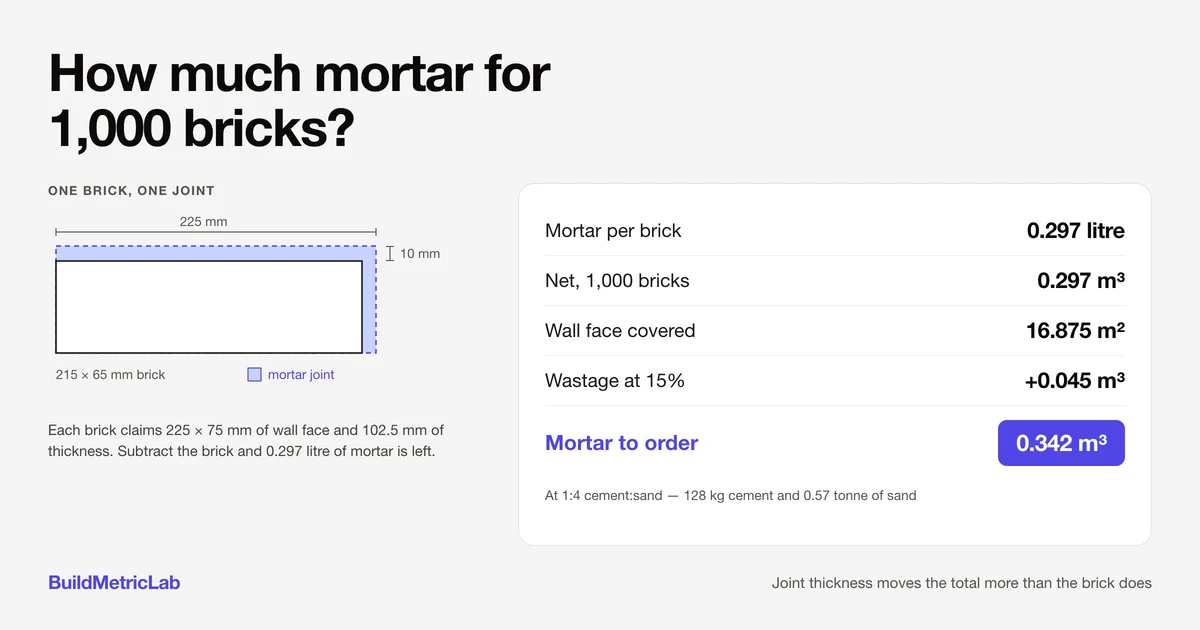
Each brick claims a nominal block of 225 × 75 × 102.5 mm, or 0.00172969 m³. The brick itself is 0.00143244 m³. The difference is 0.00029725 m³ — 0.297 litre, about 18 cubic inches, per brick.
Across 1000 units that is 0.297 m³ (10.5 cu ft) net, over 16.875 m² (182 sq ft) of wall face. Per square metre of brickwork it works out at 0.0176 m³, which is the figure worth carrying in your head.
Now the allowance. Estimating practice puts mortar waste at 15 to 25 per cent of the net quantity. That is against about 5 per cent for the bricks themselves, and it covers droppings, board scrapings and the tail end of a mixer load. At 15 per cent the order becomes 0.342 m³ (12.1 cu ft, or 0.45 cu yd).
For a 1:4 cement:sand mix the dry volume is 0.342 × 1.30 = 0.444 m³. One fifth is cement: 0.0889 m³, which at 1,440 kg/m³ weighs 128 kg (282 lb). That is six bags of 25 kg, three of 50 kg, or three 94 lb sacks — the last of which lands almost exactly on 128 kg. Four fifths is sand: 0.356 m³, weighing about 569 kg (1,254 lb) at 1,600 kg/m³, so 0.57 tonne or 0.63 US ton. Our guide to bags of cement per cubic metre covers how that bag count shifts with the mix.
A useful sanity check falls out of that. The sand volume, 0.356 m³, sits within 4 per cent of the finished mortar volume. That is the old trade rule restated: a cubic foot of loose damp sand yields about a cubic foot of mortar.
If your sand figure strays far from your mortar figure, the ratio or the dry factor has gone astray.
The same job in imperial units
Working natively in inches changes the answer, because the brick is a different size. A US modular brick of 3⅝ × 2¼ × 7⅝ in (92 × 57 × 194 mm) at ⅜ in joints claims a nominal block of 8 × 2⅝ in on the face, which leaves 13.9 cu in of mortar per unit. So 1000 of them need 8.1 cu ft (0.23 m³) net, across 146 sq ft (13.5 m²) of wall.
Widen the joint to ½ in and the same 1000 bricks take 10.9 cu ft — a 35 per cent jump for one eighth of an inch, and a fair illustration of why joint thickness is the input to get right.
Using the mortar calculator
The mortar calculator works from wall area rather than unit count, so it suits an estimate taken off a drawing. It asks for net wall area in square metres, wall type as brickwork or blockwork, and a wastage percentage. It returns the mortar volume to order, an approximate sand volume, a count of 25 kg cement bags, and a lime figure for mixes that use it.
Enter the area net of openings. Windows, doors and gate openings come off first, and a net wall area calculator handles that step if the elevation is complicated.
The calculator applies a per square metre rate — 0.022 m³/m² for brickwork, 0.010 m³/m² for blockwork — rather than the unit geometry set out above. The brickwork rate deliberately sits above the 0.0176 m³/m² that solid bricks give, because most facing bricks are frogged or perforated: a filled frog adds roughly 0.16 litre per brick, which would take a fully bedded frog up wall to about 0.027 m³/m². Feed it 16.875 m² at 15 per cent and it returns about 0.43 m³, against the 0.342 m³ the solid brick geometry gives for the same wall.
Which figure to order against depends on the unit. For solid bricks, or perforated ones laid without filling the perforations, the geometric figure is closer. For frogged bricks laid frog up and filled, as most specifications require, the calculator's rate is the safer basis. Its cement bag count assumes a general purpose mix of around 1:6; a richer 1:4 draws close to a third more cement per cubic metre, so take the split from the worked example above where the specification calls for it.
Common scenarios
Cavity and double leaf walls
Two leaves double the unit count but leave the per unit figure untouched, since each leaf is still one brick wide. An open cavity takes no mortar, so 2000 units come to 0.594 m³ (21.0 cu ft) net. A solid wall with a mortared collar joint between the leaves is a different animal. That vertical layer is simply thickness times area: a 10 mm collar adds 0.10 m³ per 10 m² of wall, and it is easy to leave out entirely.
Concrete blockwork
A 440 × 215 × 100 mm block — a concrete masonry unit or CMU in North America — takes about 0.665 litre per unit. That is more than twice a brick. Per square metre it drops to roughly 0.0066 m³ against 0.0176 m³ for brickwork, because one block covers the face area of six bricks, so a square metre of blockwork carries far fewer joints. Hollow blocks bedded on their face shells only, as structural blockwork usually is, come down further still, by about the void percentage of the unit. The concrete block calculator carries the unit counts those figures multiply.
Bonds with headers
Flemish and English bond turn units through the wall, adding joint area that running bond never sees. Trade correction factors add about one ninth to the mortar for Flemish bond and one sixth for English bond. On a decorative garden wall in Flemish bond, 0.297 m³ becomes 0.330 m³ before any wastage is applied.
Repointing rather than building
Raking out and refilling joints on a standing elevation is a surface calculation, not a volume of full joints. Only the outer 15 to 25 mm (0.6 to 1.0 in) gets replaced, conventionally at least twice the joint width. A repointing mortar calculator fits that job far better than a build from new figure.
Common mistakes
- Using a 5 per cent wastage allowance — that is the figure for the bricks, not the mortar. Mortar waste runs at 15 to 25 per cent in trade estimating practice, and hand mixing on a board sits at the upper end of that range.
- Treating frogged bricks as solid — a frog of roughly 190 × 85 × 10 mm holds 0.16 litre. Laid frog up and filled, as most specifications require, that adds more than half again to the 0.297 litre sitting in the joints.
- Working from gross wall area — window and door openings come off the area before the unit count is set, or the order carries brickwork that never gets built.
- Batching damp sand by volume — sand at 4 to 6 per cent moisture bulks by 20 to 30 per cent, so a measured bucketful holds less actual sand than a dry one. Batching by mass sidesteps the problem.
- Skipping the dry volume factor — applying the mix ratio straight to the wet mortar volume understates both cement and sand by close to a quarter.
Sources and methodology
The method here is standard masonry quantity practice: nominal unit volume less true unit volume, multiplied by unit count. Both the metric and the imperial examples are worked from that same geometry, using the coordinating dimensions of each format. Wastage is applied to the order figure rather than the net one.
The dry volume factor of 1.30, and densities of 1,440 kg/m³ for cement and 1,600 kg/m³ for loose dry sand, are conventional design values. Supplier data sheets take precedence where they differ, and damp sand will read lower.
Mortar specification is covered by EN 998-2 in Europe, ASTM C270 in the United States and Canada, and AS 3700 in Australia and New Zealand. Each is cited as an example rather than a universal requirement. Confirm the applicable standard and mix type with your local building regulations or codes.
- Brick Industry Association, Technical Note 10 — dimensioning and estimating brick masonry
- Brick Industry Association, Technical Note 8 — mortars for brickwork
- The Concrete Centre masonry publications — technical design guidance on masonry
Putting it together
The estimate rests on one geometric idea. Each unit claims a nominal block of wall, and the space left once the unit is subtracted is the mortar. For standard metric bricks at 10 mm joints in a single leaf, that lands at 0.297 m³ net, and around 0.342 m³ ordered at a 15 per cent allowance. At 1:4 it splits into roughly 128 kg of cement and 0.57 tonne of sand.
Change the unit format, the joint, the bond or the wall thickness and every one of those figures moves — often by more than the change seems to warrant. Running the actual dimensions through the mortar calculator ties the order to the wall in front of you rather than to a remembered rule of thumb.
Frequently asked questions
How much mortar is needed for 1000 bricks in a single leaf wall?
A single leaf wall of standard metric bricks at 215 × 102.5 × 65 mm with 10 mm joints holds about 0.297 m³ (10.5 cu ft) of mortar across 1000 units, covering 16.875 m² (182 sq ft) of wall face. That is the net volume sitting in the bed and perpend joints once the wall is complete. Trade practice adds 15 to 25 per cent for droppings, board waste and mixer scrapings, which lifts a realistic order to between 0.34 and 0.37 m³. US modular bricks at ⅜ in joints work out lower, at 8.1 cu ft (0.23 m³) per 1000, because the unit is smaller.
How many bags of cement are needed for 1000 bricks?
At a 1:4 cement:sand mix by volume, 0.342 m³ of finished mortar draws about 128 kg (282 lb) of cement once the dry volume factor of 1.30 is applied. That is six bags of 25 kg, three of 50 kg, or three 94 lb sacks, depending on what the local merchant carries. Richer mixes such as 1:3 raise the figure and leaner mixes such as 1:5 lower it. Where masonry cement replaces the cement and lime combination, bricklayers often work to a rule of thumb of eight bags per 1000 modular bricks, which already carries an unstated waste margin.
How much sand is needed for 1000 bricks?
The same 1:4 mix over 0.342 m³ of mortar calls for about 0.36 m³ of sand. That weighs roughly 569 kg (1,254 lb), or 0.57 tonne — near enough half a bulk bag. Building sand is the usual grade, sold as masonry sand in North America and bricklayer's sand in Australia. Its fine soft grading gives a workable mix that stands up on the trowel. Sharp or concrete sand produces a harsher mortar that is harder to lay and tools poorly. Sand volume and mortar volume run close to each other, which makes for a quick check on any estimate.
Does the mortar quantity change for concrete blocks?
Yes, and the direction catches people out. A standard 440 × 215 mm block claims 0.101 m² of nominal wall face against 0.0169 m² for a brick, so 1000 blocks build six times the area. Per unit the mortar demand more than doubles, to about 0.665 litre for a 100 mm block. Per square metre it falls to a little over a third of brickwork, 0.0066 m³ against 0.0176 m³, because far fewer joints cross the same face. Hollow units bedded on the face shells alone drop lower again, by about the void percentage of the block.