· Masonry & Brickwork
How Many Bricks Per Square Metre? The 60-Brick Rule
A standard metric brick plus a 10 mm joint covers 225 x 75 mm of wall face, which puts 59.26 bricks in every square metre. This guide explains where the 60 brick rule comes from, how coverage changes across international brick formats, and how to turn a net wall area into an order quantity.
A single skin wall 10 m long and 2.4 m high (32.81 ft × 7.87 ft) covers 24 m² and takes roughly 1,440 bricks — before you subtract a single opening or allow for one breakage. Come up short and the bricklayers stand idle waiting on a reorder. Order too many and you are paying to store packs nobody will take back. The quickest sanity check is the 60 brick rule, and the fastest way to apply it across a whole elevation is a brick calculator.
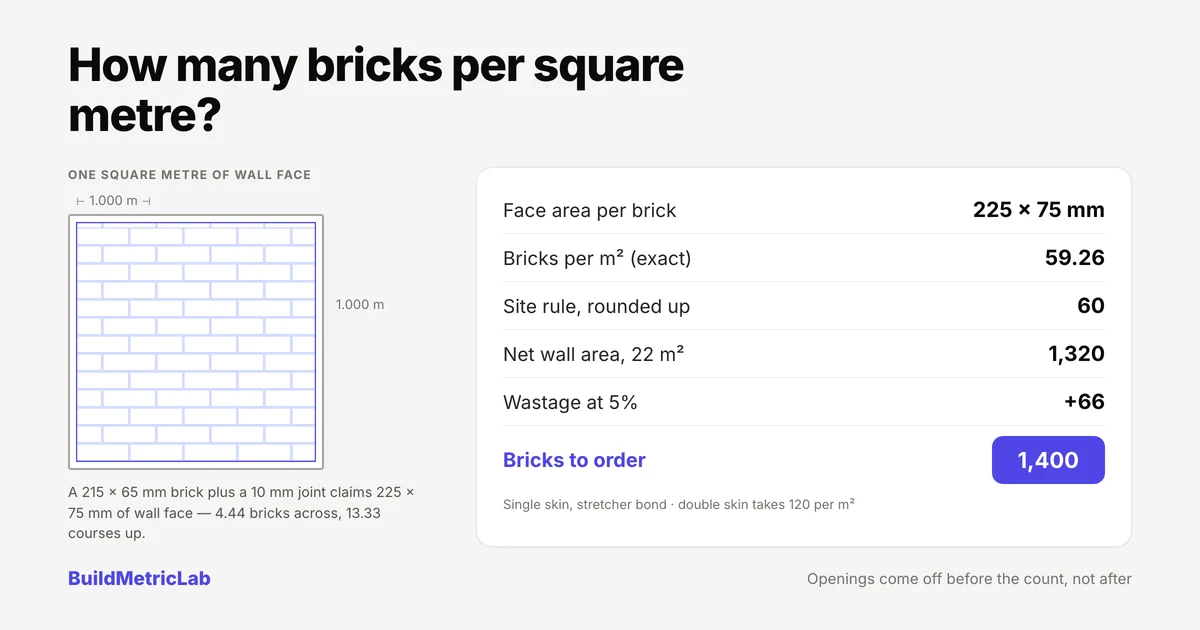
This guide covers how many bricks per square metre a standard wall needs and where the figure of 60 comes from. It also shows how coverage shifts between brick formats around the world, and how to turn a wall area into an order quantity.
What is the number of bricks per square metre?
Bricks per square metre is the count of whole facing bricks needed to cover one square metre (10.76 sq ft) of finished wall face, mortar included. A standard metric format brick measures 215 × 102.5 × 65 mm (8.46 × 4.04 × 2.56 in).
Add a 10 mm (0.39 in) mortar joint to the length and to the height, and each brick claims a face rectangle of 225 × 75 mm (8.86 × 2.95 in). Divide one square metre by that rectangle and the answer lands just under 60. That is the whole basis of the rule.
Why the number of bricks per square metre matters
Bricks arrive banded on pallets and are priced by the thousand, so the count drives the delivery schedule as much as the material bill. An estimate that runs short halts the gang mid course, and it can cost you the look of the wall: clay bodies vary between firings, so an elevation finished from a second batch often shows a colour band where the deliveries meet. The same figure feeds mortar volume, sand and cement quantities, and labour hours.
How the number of bricks per square metre is calculated
The calculation divides wall area by the face area a single brick occupies once it is bedded in mortar. The joint sits inside that face area, because every brick carries one bed joint underneath it and one vertical joint at its end — a perpend in British usage, a head joint in North America.
Bricks per m² = 1 ÷ ((L + J) ÷ 1000 × (H + J) ÷ 1000)

Total bricks = Net wall area × Bricks per m² × Skins × (1 + Wastage)
Where:
- L = brick length in millimetres, mm (in); 215 mm (8.46 in) in standard metric format
- H = brick height in mm (in); 65 mm (2.56 in) in standard metric format
- J = nominal mortar joint thickness in mm (in), typically 10 mm (0.39 in)
- Net wall area = gross elevation area minus openings, in square metres, m² (sq ft)
- Skins = 1 for a half brick wall (single wythe), 2 for a one brick wall (double wythe)
- Wastage = allowance for cuts, breakages and returns, as a decimal
Run the standard metric format through it and you get 1 ÷ (0.225 × 0.075) = 59.26 bricks per m², or 5.51 per sq ft. Rounding up to 60 is the convention on site and carries about 1.25% spare. Treat that as a rounding buffer, not a wastage allowance — wastage is separate and much larger.
A worked example
A garden wall runs 10 m long and 2.4 m high (32.81 ft × 7.87 ft), single skin in stretcher bond, called running bond in North America. One gate opening measures 1.0 m wide by 2.0 m high (3.28 ft × 6.56 ft).
- Gross elevation area: 10 × 2.4 = 24 m² (258.3 sq ft)
- Opening: 1.0 × 2.0 = 2 m² (21.5 sq ft)
- Net wall area: 24 − 2 = 22 m² (236.8 sq ft)
- Base count: 22 × 60 = 1,320 bricks
- Wastage at 5%: 1,320 × 1.05 = 1,386 bricks
- Order quantity: round up to 1,400 to suit pack sizes
Exact geometry gives 1,303.7 bricks, so rounding to 60 has already added about 16 before a single brick is wasted. A 5% allowance suits a plain rectangular run with few cuts. Walls with several openings, angled returns or a decorative bond sit nearer 10%, taking this wall to 1,452 and an order of 1,500.
How to use the brick calculator
The BuildMetricLab brick calculator asks for wall dimensions rather than a finished area. Inputs are wall length and height in metres or feet, wall thickness as single or double skin, brick format, mortar joint thickness in millimetres, and a wastage percentage.
Openings go in as width by height and are subtracted automatically, removing the most common cause of over ordering. The output shows net wall area, base brick count, wastage bricks and a rounded order quantity. Mortar follows from the same inputs, and the mortar calculator converts joint volume into sand and cement.
Common scenarios: bricks per square metre by format
Brick formats vary by market, and the coverage figure moves with them.
Standard metric format
Used across the UK, Ireland and much of Europe. At 215 × 102.5 × 65 mm with a 10 mm joint, coverage is 59.26 per m² (5.51 per sq ft), rounded to 60. A half brick garden wall of 15 m² (161.5 sq ft) comes to 900 bricks before wastage.
Modular format in the United States and Canada
Modular brick is sized so the unit plus its joint lands on a whole inch module. Nominal dimensions are 8 in long by 2 2/3 in high (203 × 68 mm), with three courses making 8 in of height. That coursing produces the standard estimating figure of 6.75 bricks per sq ft, published as 675 per 100 sq ft, or 72.66 per m². The unit itself is specified at 2 1/4 in (57 mm) high and bed joints are adjusted on site to hold the coursing, so no fixed joint dimension can be read back out of the nominal figure.
Larger formats in Australia, New Zealand and South Africa
The Australian and New Zealand standard brick is 230 × 110 × 76 mm (9.06 × 4.33 × 2.99 in). With a 10 mm joint that gives 48.45 per m² (4.50 per sq ft). A common South African format of 222 × 106 × 73 mm (8.74 × 4.17 × 2.87 in) returns 51.93 per m² (4.82 per sq ft). Blockwork shifts the picture again, and the concrete block calculator carries those coverage figures.
Common mistakes
- Using gross elevation area — doors, windows and gate openings can remove a tenth of a wall face. A net wall area calculator keeps the order aligned with what gets built.
- Leaving the joint out of the face area — dividing by the bare brick face of 215 × 65 mm returns 71.56 per m², an overstatement of about 21%.
- Applying 60 to a double skin wall — a one brick wall shows a face on each side and takes 120 per m². Miss this and the order is half what the job needs.
- Mixing metric and imperial mid calculation — an area in square feet multiplied by a per square metre figure inflates the count by a factor of 10.76.
- Ignoring the bond — header courses eat extra bricks. Flemish bond adds roughly a third to a stretcher bond count, English bond about a half.
Sources and methodology
Coverage figures here are calculated from the coordinating dimensions of each format and cross checked against published estimating guidance. Dimensional standards for clay masonry units are regional — EN 771-1 in Europe, ASTM C216 in North America, AS/NZS 4455 in Australia and New Zealand. Each states a work or specified size; the coordinating or nominal size adds the joint.
- Brick Industry Association, Technical Note 10 — modular quantity tables and bond correction factors
- The Concrete Centre masonry publications — technical design guidance on masonry and Eurocode 6
- BRE building science research — masonry materials, testing and construction standards
Putting it together
Sixty bricks per square metre holds for single skin brickwork in standard metric format, and it turns an elevation into a material order in one step. The discipline sits in what surrounds it: net area rather than gross, the format the specification actually calls for, one skin or two, and a wastage allowance sized to the cuts the design generates.
Formats differ enough between markets that the same wall takes 48 bricks per square metre in one country and 73 in another, so the method travels further than the number. Run the dimensions through a brick quantity calculator and the arithmetic stays consistent from first estimate to final order.
Frequently asked questions
How many bricks per square metre are in a standard wall?
A single skin wall in standard metric format takes 60 bricks per square metre, or 5.51 bricks per square foot. The exact figure is 59.26, based on a 215 × 65 mm brick face plus a 10 mm mortar joint on the length and the height. Rounding up to 60 is the trade convention and leaves roughly 1.25% spare. Other markets land elsewhere: modular brick in North America gives 6.75 per square foot, and the larger Australian format about 48 per square metre.
How many bricks are in a square metre of double skin wall?
A one brick wall, known as a double skin wall in Britain and a double wythe wall in North America, shows a brick face on both sides. Coverage therefore doubles to 120 per square metre, or 11.15 bricks per square foot. Cavity walls behave the same way whenever both leaves are brick, though many builds use blockwork for the inner leaf. In that case the outer leaf takes 60 per square metre and the inner leaf follows block coverage, a different figure entirely for the same wall.
What wastage allowance suits a brick order?
Allowances usually sit between 5 and 10%, and the Brick Industry Association treats 5% as the floor rather than the norm. A plain rectangular wall with square ends and few openings sits at the lower end, since most bricks go in whole. Arches, angled corners, decorative bonds and repeated openings generate off cuts that cannot be reused, pushing the figure towards 10%. Reclaimed and handmade bricks vary more and break more, so estimators often allow more again.
Does mortar joint thickness change the brick count?
Joint thickness changes the count directly, because the joint forms part of the face area each brick occupies. A 10 mm (0.39 in) joint gives 59.26 bricks per square metre. Tightening to 6 mm (0.24 in) raises coverage to 63.73, while opening out to 15 mm (0.59 in) drops it to 54.35. Thin joint systems and gauged brickwork sit well outside the 60 convention, so recalculate rather than assume. Mortar volume moves the opposite way, rising as joints widen.