Painting & Decorating
Primer Calculator
Primer in litres or gallons from area, coats and the data-sheet coverage rate, rounded to whole tins
Updated October 9, 2026 · Live
What this tool does
Works out how much primer or undercoat a surface needs from its area, the number of coats and the coverage rate on the product data sheet, in litres or US gallons, then rounds up to whole tins and prices them. Shows the coverage in both m²/L and ft²/gal and the volume bought against the volume needed.
Area times coats divided by the coverage rate gives the volume; the tin size rounds it up to what you buy.

 Scan to get

 Scan to get


 Scan to get

People also use
Formula Used
Formula Used
How the primer calculator works
Primer is the coat nobody sees and everybody underbuys. The sum is short: surface area times the number of coats, divided by the coverage rate on the tin, gives the litres or gallons; divide by the tin size and round up, and that is what to carry to the till. The default US example, 430 ft² at 300 ft² per gallon, needs 1.43 gallons, so two 1 gallon cans at $32 is $64 and the second can comes home a little over half full. The metric default, 40 m² at 8 m² per litre, is 5.00 litres exactly, two 2.5 litre tins at £28 for £56. There is no separate wastage input, and that is deliberate. A data sheet already discounts for loss: Zinsser's B-I-N Advanced primer sheet gives a theoretical coverage of 592 ft²/gal (14.5 m²/L) at one mil dry, then a practical figure of 300 to 400 ft²/gal (7.4 to 9.8 m²/L) "assuming 15% material loss", and it is the practical figure you type here. Putting another 10% on top would be paying twice for the same roller.
Coverage is the number that matters
Everything else on the page is arithmetic; the coverage rate is where the estimate lives or dies, and it comes off the product sheet, not from memory. Rates are printed per gallon in North America and per litre nearly everywhere else, and the calculator converts whichever you enter: 1 m²/L is 40.7 ft²/gal, so 300 ft²/gal is 7.4 m²/L and 13 m²/L is about 530 ft²/gal. The Coverage Used row shows both so a UK tin can be checked against a US figure. Real sheets put primers across a wide span. Dulux Trade's Quick Dry Wood Primer Undercoat is "up to 13 m² per litre", and its system calls for two coats on new or bare wood and one on previously painted surfaces. Zinsser's shellac primer sits at 300 to 400 ft²/gal "depending on application method and surface porosity", and high-build or masonry primers quote lower figures again. Bare plaster, new plasterboard, bare softwood and masonry drink the first coat, so for those the low end of the sheet's range is the honest one, and for a smooth previously painted wall the high end.
The first coat on new plaster in the UK is not usually a primer at all but a mist coat: Dulux Trade's Supermatt data sheet says to seal new or bare surfaces with a first coat thinned with up to 1 part water to 3 parts paint, against a normal coverage of up to 18 m² per litre. For that case, enter the thinned coverage you expect from the sheet, or run the sum for the paint itself; in the US the equivalent is a PVA drywall primer at the rate on its own can. Whatever the product, the surface area is the area painted, not the floor area: walls are perimeter times height less the openings you will not prime, and a ceiling is its own rectangle.
Tins, cans and the rounding
Primer is sold in fixed sizes and the calculator rounds up to whole ones, so the tin size you enter changes the cost more than anything except the coverage. The UK trade sizes are 1, 2.5 and 5 litres; North America sells quarts, gallons and 5 gallon pails. Two worked examples show the shape. A 1,200 ft² interior, two coats at 350 ft²/gal, is 6.86 gallons; in 5 gallon pails at $120 that is two pails, 10 gallons bought and $240, with 3 gallons left for the next room. A 120 m² run of bare timber cladding, two coats at 13 m²/L, is 18.46 litres; in 5 litre tins at £45 that is four tins, 20 litres and £180. Change the pail to 1 gallon cans at $32 and the first example becomes seven cans and $224, cheaper on the day and dearer per gallon. The Bought row shows the volume you are paying for against the volume the wall needs, which is the number to look at before deciding whether the next tin size up is worth it.
Coats, surfaces and what counts
One coat of primer is the norm on a sound, previously painted surface where the job of the primer is adhesion or stain blocking; two coats go on bare wood, bare metal, patched plaster and anything the first coat soaks into unevenly, and a shellac or oil stain blocker over knots, water marks or smoke needs a second coat only where the stain still shows. Spot priming of filler is a separate, smaller area. The calculator multiplies the whole area by the coat count, so for a wall that needs two coats on the patched parts and one everywhere else, run it twice or enter one coat and buy a little over. Primer on a ceiling and primer on trim are different products at different rates; run each on its own.
Old paint and lead
Preparing a surface for primer is where lead paint becomes a problem, because sanding and scraping make the dust. In the United States the EPA Renovation, Repair and Painting Rule applies to anyone paid to disturb painted surfaces in homes, childcare facilities and preschools built before 1978, the year lead paint was banned for residential use; the EPA notes that about three-quarters of pre-1978 homes still contain some. In Great Britain the Health and Safety Executive lists stripping or preparing leaded paint from doors and windows as a significant exposure task under the Control of Lead at Work Regulations 2002, and lead pigments were widely used in domestic paints until the 1960s and not out of all common paints until the early 1980s. If the house is of that age and the paint is old, test before sanding, or wet-scrape and prime over sound paint instead of taking it back.
What the calculator leaves out
It does not count the topcoat; the exterior paint calculator and the painting cost calculator do that. It assumes brush or roller application at the sheet rate; spraying loses more to overspray and the spray paint calculator allows for it. It does not thin anything; the paint thinning calculator works out the water or solvent and the thinned volume. And it knows nothing about the weather. Data sheets quote dry and recoat times at a stated temperature and humidity, 70 to 80°F (21 to 27°C) and 50% relative humidity on the Zinsser sheet, and below the product's minimum application temperature the coat may not cure at all, so the tin count is right but the day may be wrong.
Using this with other BuildMetricLab tools
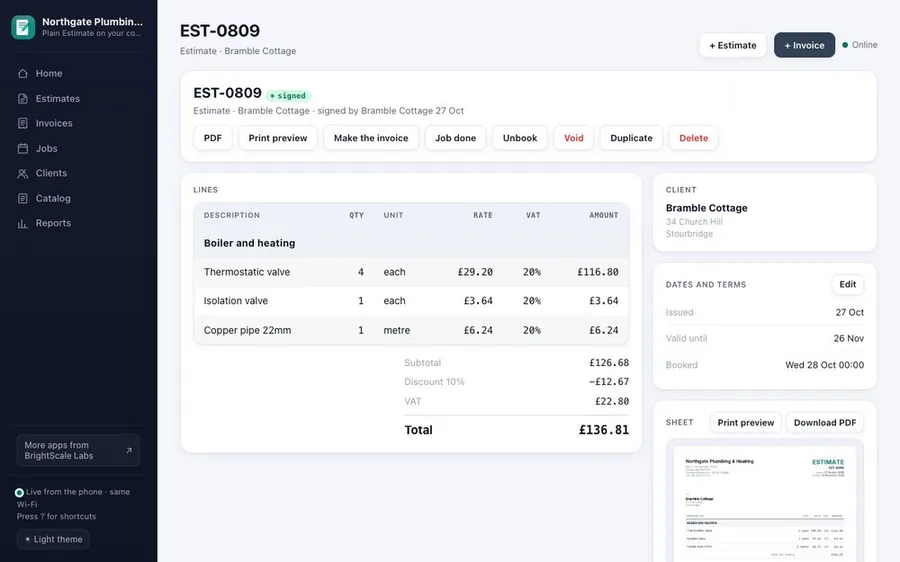
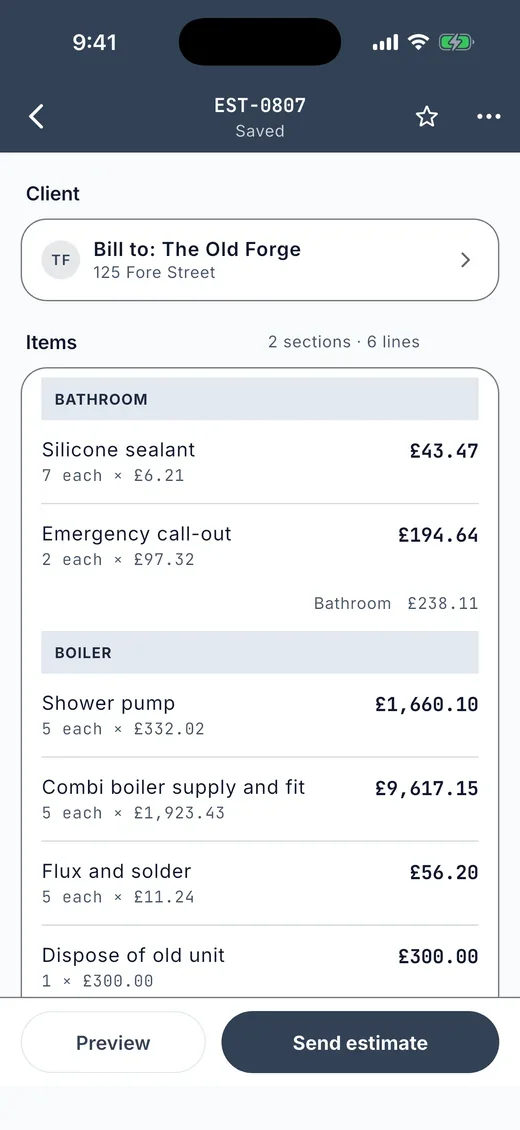
Measure the wall with the drywall calculator if the room is being boarded, run the primer here, then the topcoat and the labour, and send the tins to PlainEstimate from the result card. All BuildMetricLab tools run in your browser with no sign-up, and the formula is on the page so the maths can be checked.
Sources & methodology
Primer required = surface area × coats ÷ coverage, with coverage in m²/L (a US entry in ft²/gal is converted first: 1 ft²/gal = 0.02454 m²/L). Tins = primer required ÷ tin size, rounded up; bought volume = tins × tin size; cost = tins × price per tin. No wastage percentage is applied: a data sheet's practical coverage already discounts for loss (Zinsser B-I-N Advanced: 592 ft²/gal theoretical at 1 mil, 300 to 400 ft²/gal practical assuming 15% material loss). Displayed equivalents use 1 US gal = 3.785 L and 1 m² = 10.764 ft².
- Rust-Oleum, Zinsser B-I-N Advanced Synthetic Shellac Primer, technical data sheet: theoretical 592 ft²/gal (14.5 m²/L), practical 300 to 400 ft²/gal (7.4 to 9.8 m²/L) assuming 15% material loss; dry times at 70 to 80°F and 50% RH
- Dulux Trade, Quick Dry Wood Primer Undercoat, technical data sheet 202: practical coverage up to 13 m²/L; two coats on new or bare surfaces, one on previously painted
- Dulux Trade, Supermatt, technical data sheet 410: seal new or bare surfaces with a first coat thinned up to 1 part water to 3 parts paint; coverage up to 18 m²/L
- US EPA, Lead Renovation, Repair and Painting Program: pre-1978 homes, certified renovators, lead-safe work practices
- HSE (Great Britain), Construction hazardous substances: Lead; Control of Lead at Work Regulations 2002, stripping or preparing leaded paint as a significant exposure task
Frequently asked questions
Are primer calculator results accurate enough to order materials?
Yes, if the coverage rate comes from the product data sheet and the area is the area you will actually prime. The sheet's practical rate already includes typical loss, so the litres or gallons are what the surface needs; the tin count is rounded up, so there is a part tin spare for touching in. On very porous surfaces use the low end of the sheet's range or you will run short on the first coat.
What wastage percentage should I use?
None; this calculator has no wastage input. The coverage rate on a data sheet is a practical figure that already discounts for loss (Zinsser quotes a theoretical 592 ft²/gal and a practical 300 to 400 ft²/gal assuming 15% material loss), and rounding up to whole tins adds a margin on top. Lower the coverage you enter for porous or textured surfaces instead of adding a percentage.
Does this replace professional advice?
No. It counts primer; it does not tell you which primer, how many coats a surface needs, or whether old paint is safe to sand. Check the product sheet for the system, and if the building is old enough to have lead paint, test before preparing the surface and use a certified contractor where the rules require one. For anything affecting structure, gas, electrics, plumbing or drainage to a public sewer, use a suitably qualified professional.
Can I change the unit prices?
Yes. The tin size and the price per tin are both inputs; enter the size you will buy and the shelf price, and the cost is the number of tins times that price. Try the next size up to see whether the cheaper per-litre rate beats the extra part tin.
Spotted something off?
Calculations or display — let us know.
Related tools
Calculators from other categories that planners often reach for next.