· Masonry & Brickwork
Render Coverage Per Square Metre: Sand, Cement and Bags
Render coverage per square metre turns wall area and coat thickness into cement bags and sand tonnages. This guide sets out the formula, a worked metric example with imperial equivalents, the bag sizes used in different markets, and the wastage allowance to add before ordering.
A gable 8.0 m by 4.5 m (26 ft 3 in by 14 ft 9 in) with one window and one door in it leaves 32.67 m² (352 sq ft) of wall to cover. Two coats at 18 mm swallow 0.588 m³ (20.8 cu ft) of wet mortar. Buy the ingredients loose rather than the finished mortar, though, and the same wall takes 1.12 tonnes (1.24 US tons) of sand. The gap between those two numbers is where render orders go wrong.
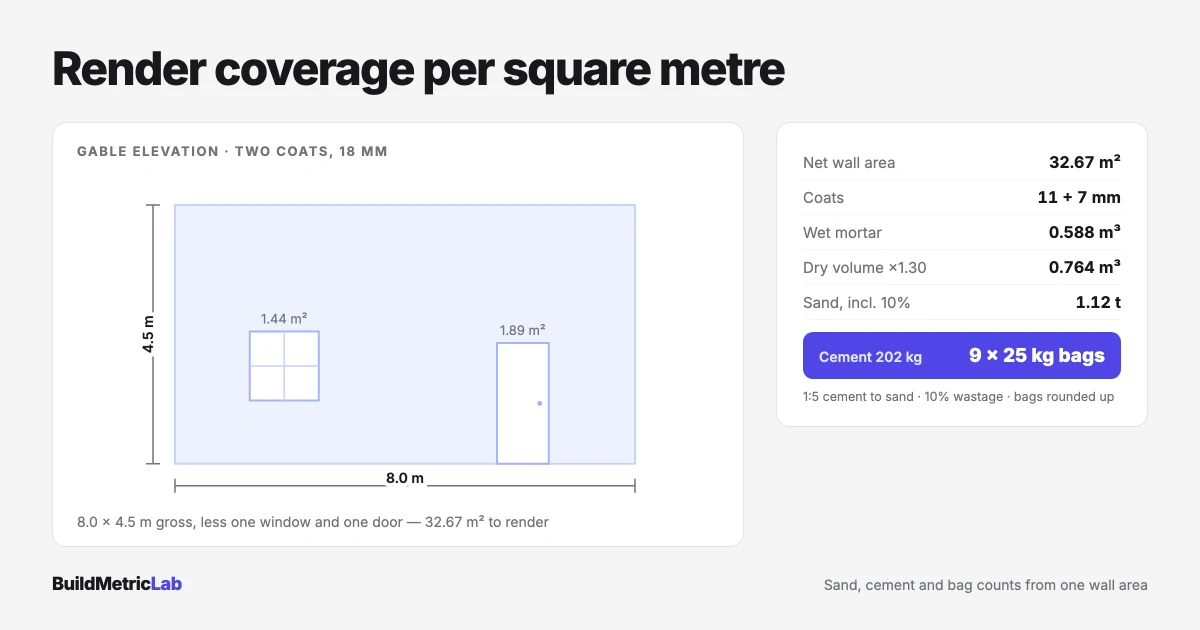
Render coverage per square metre is the bridge between a wall area and a delivery note. The plaster and render calculator does the arithmetic in one pass. What follows is the method underneath it, in metric with imperial equivalents, so the figures travel whether the job is priced in square metres or square feet.
What render coverage measures
Render is sand and a binder, spread on masonry to shed water and give a finished face. The word changes with the passport. Render in Britain, Ireland, Australia and New Zealand; stucco across North America; plaster through India and much of the Gulf. Same material, same arithmetic, different invoice heading.
Coverage is the quantity of material a stated thickness consumes over one square metre (10.76 sq ft) of wall. Mix is the proportion of binder to sand as parts by volume, so a 1:5 cement to sand ratio means one part cement to five parts sand. Sand naming varies too: plastering sand, rendering sand, soft sand and masonry sand all point at the same fine, well-graded material, as distinct from the coarse concreting sand used in a slab.
Why thickness and mix move the numbers
Volume tracks coat thickness in a straight line, which sounds obvious until the figures are in front of you. On the example wall, going from 18 mm (0.71 in) to 22 mm — a difference nobody spots by eye across a gable — lifts material demand by 22.2 per cent. Four millimetres, a fifth more of everything.
Mix proportion behaves differently. Enriching a 1:5 to a 1:4 raises cement demand from about 5.6 kg (12.3 lb) per square metre to 6.7 kg, while sand drops slightly. The reason not to enrich casually is structural rather than financial. A render harder than the wall behind it concentrates movement into cracks instead of spreading it thinly across the face, which is why softer and older backgrounds are commonly specified with weaker, lime-gauged mixes.
Then there is the plain logistics of it. Cement arrives in whole bags, sand in whole tonnes or bulk bags. A shortfall of ten kilograms stops a run mid-wall while somebody drives to the merchant; an overrun sits in the corner of the site going hard.
How render coverage per square metre is calculated
Four steps take a wall area to an order list.
Net area multiplied by total coat thickness gives the volume of finished wet mortar. That figure then gets scaled up, because a heap of loose sand plus a bag of cement occupies more space than the mortar it eventually makes — paste and fines settle into the voids between the sand grains and the pile shrinks. The scaled figure, the dry volume, is what gets split by the mix ratio and converted to mass.
Wet mortar volume (m3) = Net area (m2) x Total thickness (m)
Dry volume (m3)        = Wet mortar volume (m3) x Dry volume factor
Total parts            = Cement parts + Lime parts + Sand parts
Material volume (m3)   = Dry volume (m3) x Material parts / Total parts
Material mass (kg)     = Material volume (m3) x Bulk density (kg/m3)
Where:
- Net area — wall area in m² (sq ft) after openings are deducted
- Total thickness — every coat added together, entered in m, specified in mm (in)
- Dry volume factor — a dimensionless allowance for voids, commonly 1.25 to 1.35
- Parts — the figures in the mix ratio, dimensionless; a 1:5 mix has six total parts, a 1:1:6 cement:lime:sand mix has eight
- Bulk density — loose mass per unit volume in kg/m³ (lb/cu ft): roughly 1440 kg/m³ (90 lb/cu ft) for cement, 1600 kg/m³ (100 lb/cu ft) for dry sand, around 600 kg/m³ for hydrated lime
Two things sit outside this calculation, and they get confused with it often enough to be worth separating. Water is added to reach workability rather than to a fixed dose, so it never appears in the quantities. And damp sand bulks — a wet heap can occupy 20 to 30 per cent more space than the same mass dry — which only bites when sand is gauged by volume in a bucket or gauging box on site, not when it arrives by mass.
A worked example, start to finish
The gable is 8.0 m by 4.5 m: 36.00 m² (387.5 sq ft) gross. A window at 1.44 m² (15.50 sq ft) and a door at 1.89 m² (20.34 sq ft) come off, leaving 32.67 m² (351.7 sq ft) net. The specification is a two coat system — an 11 mm (0.43 in) undercoat, which North American practice calls the scratch coat, and a 7 mm (0.28 in) finish — for 18 mm (0.71 in) total, in a 1:5 cement to sand mix.
Wet mortar volume comes first. Multiplying 32.67 m² by 0.018 m gives 0.588 m³ (20.8 cu ft), or 18 litres (4.8 US gallons) for every square metre. A dry volume factor of 1.30 takes that to 0.764 m³ (27.0 cu ft) of loose material.
The 1:5 ratio splits the dry volume into six parts, one cement and five sand: cement 0.127 m³ (4.50 cu ft), sand 0.637 m³ (22.50 cu ft). Bulk density turns those into 183 kg (404 lb) of cement and 1,019 kg (2,247 lb) of sand, which is 5.6 kg and 31.2 kg per square metre of wall.
Wastage comes last. Between 5 and 10 per cent covers what lands on the boards, what stiffens in the drum and what gets scraped out at the end of a run. At 10 per cent the order becomes 202 kg (445 lb) of cement and 1,121 kg of sand, which is 1.12 tonnes or 1.24 US tons. The sand and cement render calculator reproduces every one of those figures from the same four inputs.
Turning kilograms into bags
Cement sells in whole bags, and the bag is not the same size everywhere. This is the step most likely to trip up a coverage figure lifted from a website written for another market.
Common bag masses run 20 kg and 25 kg across much of Europe, Ireland, Australia and New Zealand; 40 kg in parts of Canada and Asia; 50 kg through India, China and Pakistan; and 94 lb, or 42.64 kg, in the United States — a size that traces back to roughly one cubic foot of packed cement. The 202 kg from the worked example lands like this:
- 20 kg bags — 10.09, so 11
- 25 kg bags — 8.07, so 9
- 40 kg bags — 5.05, so 6
- 50 kg bags — 4.04, so 5
- 94 lb (42.64 kg) bags — 4.73, so 5
Rounding goes up in every case. Part-used cement pulls moisture from the air and goes lumpy within days of a bag being opened, so a spare bag is worth more than the money saved by cutting it fine. The 5.05 and 4.04 results make a second point: a fraction over a whole bag costs a whole bag, which is an argument for settling bag size before the order rather than after.
Using the plaster and render calculator
The render coverage calculator takes four inputs: net wall area, total coat thickness, cement to sand ratio, and wastage percentage. Out come wet mortar volume, dry volume, cement mass with a bag count at the selected bag size, and sand mass in kilograms and tonnes.
Two habits make the output more reliable. Openings come off before the area goes in, and the coat thickness entered is the specified thickness rather than what a perfectly flat background would take — no masonry wall is perfectly flat. Where a wall is badly out of true, plasterers dub out the hollows first, and that dubbing is material the specification never mentions.
Once quantities settle, the rendering cost calculator turns them into a project figure using a rate in whatever currency the job is priced in, before local sales tax or VAT.
Four common jobs
Internal skim over plasterboard
A 12 m² (129 sq ft) wall taking one 6 mm (0.24 in) coat comes to 0.072 m³ (2.54 cu ft), or 72 litres. The catch is the material rather than the maths: plasterboard, drywall in North America, is normally skimmed with a gypsum finish and not with sand and cement, and gypsum products carry a coverage rate per bag on the data sheet.
Three coat render on new blockwork
Sixty square metres (646 sq ft) at 25 mm (0.98 in) across three coats gives 1.500 m³ (53.0 cu ft) wet and 1.950 m³ dry. At 1:5 that is 468 kg of cement — 18.72 bags at 25 kg, so 19 — and 2.60 tonnes of sand, before any wastage. Coat sequences and nominal thicknesses for this kind of work are set out in EN 13914-1 across Europe and in ASTM C926 in the United States, the latter putting two coat work over unit masonry at 5/8 in nominal, close to 16 mm, and three coat work over metal lath at 7/8 in, about 22 mm.
A lime-gauged mix on an older wall
Where the background is soft or historic, a cement:lime:sand mix spreads movement instead of concentrating it. A 1:1:6 on the same 32.67 m² gable at 18 mm comes to 138 kg of cement, 57 kg of hydrated lime and 917 kg of sand. There is a neat coincidence worth knowing: a 1:½:4½ mix carries exactly the same cement content as a 1:5, since both total six parts, so the lime buys workability and movement tolerance without making the render any harder.
Patch repair and raked joints
On small repairs the ratio matters more than the quantity, because a patch stronger than what surrounds it shows as a hairline crack round its edge inside a season or two. Where joints are raked out and refilled rather than faced over, the repointing mortar calculator works from joint dimensions rather than wall area.
Where render estimates go wrong
- Working from gross area. The example gable loses 3.33 m² (35.8 sq ft) to one window and one door — 9.25 per cent of the gross figure, and that is modest glazing for a house wall.
- Leaving out the dry volume factor. Ordering loose material equal to the wet mortar volume under-supplies by 23.1 per cent on a 1.30 factor — the largest single error available here, and the easiest to make, because the wet volume looks like a finished answer.
- Mixing unit systems. Square feet multiplied by millimetres produces a number, and the number means nothing. Conversion belongs before the multiplication, not after it.
- Treating the background as flat. An average of 4 mm (0.16 in) of extra build across the example wall is another 131 litres of mortar, more than a fifth on top of the specified quantity.
- Ordering with no wastage allowance. Five to ten per cent is standard practice, and the lower end of that assumes a tidy site and machine mixing.
Sources and methodology
The method above follows standard mortar practice: volume from area and thickness, a dry volume allowance to move from finished mortar back to loose ingredients, and mass from bulk density. Every figure in this article was recalculated from those steps rather than read off a coverage table, and the worked example reproduces in the calculator.
Binder types, the role of lime, and the reasoning behind mix proportions are set out by The Concrete Centre. Application standards are regional rather than universal: ASTM C926 governs Portland cement-based plaster in the United States and is referenced by the IBC and IRC, while EN 13914-1 covers external rendering across Europe. Australia and New Zealand work to AS/NZS standards, and India to the relevant IS codes. Local building regulations and the project specification take precedence over any general figure here.
- The Concrete Centre: mortar, binders and lime
- ASTM C926: application of Portland cement-based plaster
Putting it together
Render quantities come down to four decisions: net area, coat thickness, cement to sand ratio and wastage. Settle those four and the arithmetic follows without argument, in any market and either unit system.
What the example wall shows is how fast the numbers pull away from intuition. A net 32.67 m² at 18 mm turns 0.588 m³ of mortar into 202 kg of cement and 1.12 tonnes of sand once voids and wastage are accounted for, and the bag count on that same 202 kg swings between five and eleven depending on which country the merchant is in.
Running the figures before an order goes in produces a bag count and a sand tonnage that can be checked against what a supplier can actually deliver — and revisited whenever the specification moves.
Frequently asked questions
How much sand and cement do I need per square metre of render?
At 18 mm thickness in a 1:5 cement to sand mix, a square metre takes 5.6 kg of cement and 31.2 kg of sand, which is 18 litres of wet mortar. Those figures rest on a dry volume factor of 1.30, cement at 1440 kg per cubic metre and sand at 1600 kg per cubic metre. Thickness scales in a straight line, so the same mix at 12 mm comes to about 3.7 kg of cement and 20.8 kg of sand per square metre before wastage. Both figures are pre-wastage; adding 10 per cent is common practice before an order goes in.
What is the standard mix ratio for external render?
Common practice runs 1:5 or 1:6 cement to sand for undercoats, with a slightly weaker finish coat, though the background governs the choice far more than habit does. A render harder than the masonry beneath it concentrates movement into cracks rather than spreading it, so softer substrates tend to take weaker mixes, often gauged with lime. Cement demand moves with the ratio: at 18 mm, a 1:4 takes about 6.7 kg per square metre, a 1:5 about 5.6 kg and a 1:6 about 4.8 kg. Local building regulations and the relevant national standard set the actual limits.
How thick should render be?
Two coat external systems commonly total 15 mm to 20 mm, with the undercoat thicker than the finish. Three coat work on rough or exposed backgrounds runs to 25 mm or more, while internal finishes are often 2 mm to 6 mm. ASTM C926 sets nominal minimums of 5/8 in over unit masonry and 7/8 in over metal lath for guidance in the United States; EN 13914-1 covers the equivalent ground in Europe. Thickness drives volume directly, so a 20 per cent increase in thickness is a 20 per cent increase in material. Thick single passes tend to slump, which is exactly why systems are specified in coats.
How do I convert render coverage per square metre into bags of cement?
Multiply the cement mass per square metre by the net area, add the wastage allowance, divide by the bag mass and round up. On a 32.67 m² wall at 5.6 kg per square metre, that is 183 kg before wastage and 202 kg with 10 per cent added. Bag size is where the answer diverges by market: 202 kg is 8.07 bags at 25 kg, so nine; 10.09 at 20 kg, so eleven; 4.73 at the 94 lb (42.64 kg) American sack, so five; and 4.04 at 50 kg, so five again. Rounding always goes up, because opened cement absorbs moisture quickly.