· Concrete & Foundations
How Much Concrete Do I Need? Slabs, Footings and Volume
Work out how much concrete a slab, footing or pad needs, with a plain worked example, the volume formula and a free calculator. Metric throughout, with imperial equivalents.
A slab 6 m by 4 m (about 20 ft by 13 ft) at 100 mm (4 in) thick takes 2.4 m³ (3.14 cu yd) of concrete — and that is before you allow a drop for spillage. The question "how much concrete do I need?" comes down to that one figure, and getting it right is the difference between a single clean delivery and a pour that stops halfway while someone runs off for more mix.
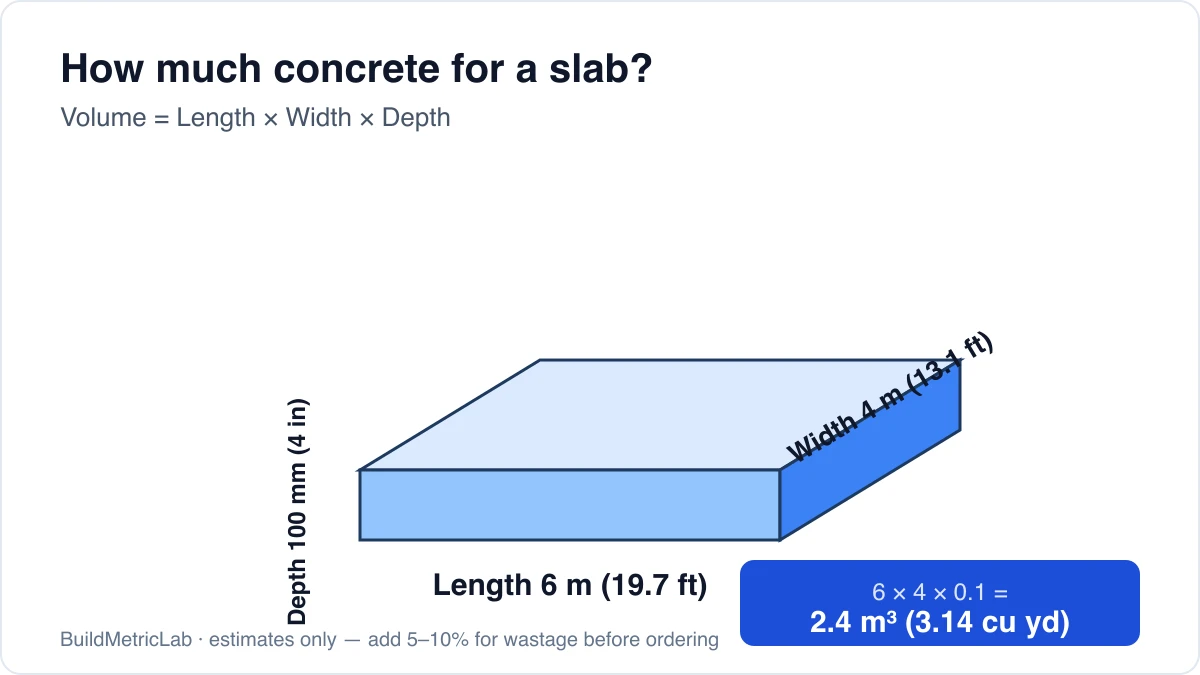
The concrete slab calculator gives you the number in a few seconds, but it helps to know where it comes from. This guide walks through how the volume is worked out, with a full metric example and imperial equivalents in brackets, then covers footings, awkward shapes and the familiar question of bags versus ready-mix. By the end you'll be able to size any rectangular, L-shaped or circular pour without second-guessing it.
What "how much concrete do I need" really means
Underneath the question is a single quantity: the volume of wet mix, measured in cubic metres (m³, or cubic feet and cubic yards in imperial markets), needed to fill a shape to a given depth. It is pure geometry — the area of the pour multiplied by its thickness. A driveway, a strip footing and a small pad are all the same idea: area times depth gives the space the concrete has to fill. Everything that comes after, from ordering bags to booking a truck, follows from that one number.
Why getting the volume right matters
Concrete does not wait. Once it is mixed, it heads towards its set on its own schedule, so a pour that runs short cannot simply be paused while more is fetched. Order too little and you risk a cold joint, where fresh mix meets concrete that has already started to go off. Order far too much and you are paying to barrow the excess away. Both problems trace straight back to the volume figure.
That number also drives the decisions around it. It tells you whether the job is a bag-mixing afternoon or a ready-mix delivery, how many loads a large pour needs, and whether you have to arrange access for a truck. Work it out early and those choices turn from guesswork into arithmetic — which tends to make the day of the pour a good deal calmer.
How to work out the volume
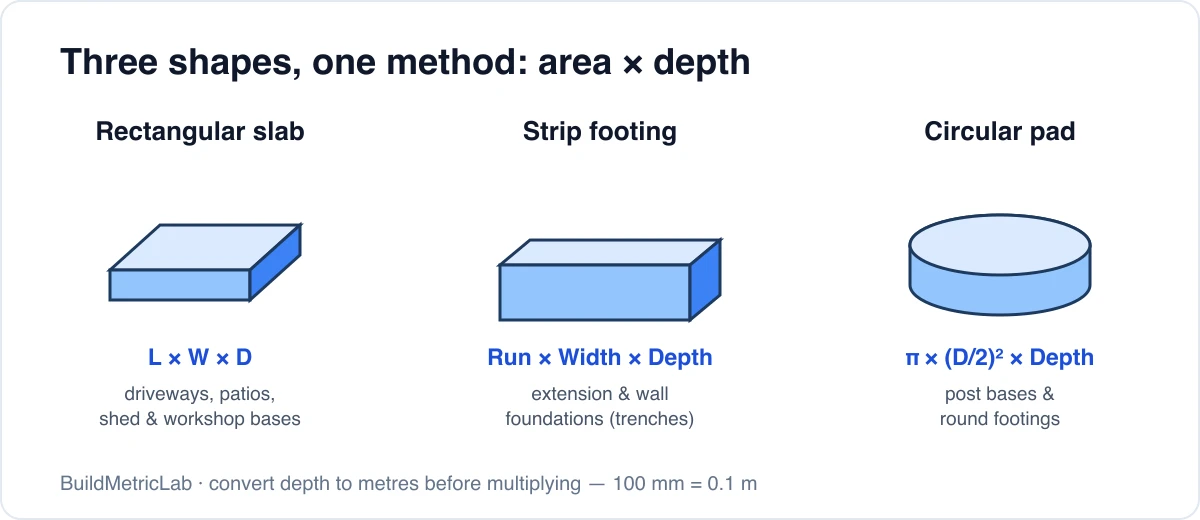
For a rectangular slab it is area multiplied by depth. The one trap is units: convert the depth from millimetres to metres before you multiply, so the answer lands in cubic metres. Footings use the same prism formula with the trench dimensions instead. Circular pads swap the rectangle for the area of a circle. Anything more complicated gets broken into simple pieces, each worked out on its own and then added together.
Volume (m3) = Area (m2) x Depth (m)

Rectangular slab:  V = Length x Width x Depth
Strip footing:     V = Run length x Trench width x Trench depth
Circular pad:      V = pi x (Diameter / 2)^2 x Depth
Where:
- Length, Width, Run length = horizontal dimensions in metres (m; feet in imperial)
- Depth / Thickness = vertical dimension in metres (m), usually entered in millimetres (mm; inches) and converted
- Area = surface the concrete covers in square metres (m²; square feet)
- Volume = the result in cubic metres (m³; cubic feet or cubic yards)
A worked example: how much concrete do I need for a slab
Say you are laying a base for a garden workshop. The slab is 6 m (19.7 ft) long by 4 m (13.1 ft) wide, poured 100 mm (3.9 in) thick over a prepared sub-base.
Start with the area: 6 m × 4 m = 24 m² (258 sq ft). Convert the depth next — 100 mm is 0.1 m. Multiply the two together: 24 m² × 0.1 m = 2.4 m³ (84.8 cu ft, or 3.14 cu yd). That is the net volume, the exact space the slab occupies.
Then add something for wastage. Spillage, over-dig and uneven ground all mean the amount you order should sit a little above the net figure. At 10% it becomes 2.4 m³ × 1.10 = 2.64 m³ (3.45 cu yd); at 5% it would be 2.52 m³ (3.3 cu yd). Round only at this last step, so the figures you carry through stay clean. For a single pour this size, 2.64 m³ is a sensible amount to order.
The concrete slab volume calculator runs exactly these steps and hands back both the net and the wastage-adjusted figures, so the ordering number already carries its margin. For long, narrow elements, a concrete footing calculator applies the same prism method to trench dimensions rather than slab dimensions.
Concrete volume for common slab sizes
The table below gives the net volume for a range of everyday slab sizes at two common thicknesses. These are exact geometric figures — add a 5 to 10% wastage margin before ordering.
| Slab size (L × W) | Area | 100 mm (4 in) thick | 150 mm (6 in) thick |
|---|---|---|---|
| 3 × 2 m (10 × 6.6 ft) | 6 m² | 0.60 m³ (0.78 cu yd) | 0.90 m³ (1.18 cu yd) |
| 4 × 3 m (13 × 10 ft) | 12 m² | 1.20 m³ (1.57 cu yd) | 1.80 m³ (2.35 cu yd) |
| 5 × 3 m (16 × 10 ft) | 15 m² | 1.50 m³ (1.96 cu yd) | 2.25 m³ (2.94 cu yd) |
| 6 × 4 m (20 × 13 ft) | 24 m² | 2.40 m³ (3.14 cu yd) | 3.60 m³ (4.71 cu yd) |
| 8 × 3 m (26 × 10 ft) | 24 m² | 2.40 m³ (3.14 cu yd) | 3.60 m³ (4.71 cu yd) |
| 10 × 5 m (33 × 16 ft) | 50 m² | 5.00 m³ (6.54 cu yd) | 7.50 m³ (9.81 cu yd) |
How to use the concrete slab calculator
The concrete slab calculator asks for three things: the slab's length, width and thickness. Enter length and width in metres (or feet, using the imperial toggle) and thickness in millimetres (or inches); the tool handles the conversion, so you never mix the two systems by hand. A wastage field lets you set the 5 to 10% allowance directly rather than adding it on afterwards.
Out comes the net volume and the ordered volume including wastage, both in cubic metres with cubic-yard equivalents alongside. Treat the ordered volume as the number to give a supplier, and the net volume as the true size of the slab. When a pour is big enough to arrive by truck, a ready-mix truck volume calculator then turns that volume into loads and part-loads.
Common scenarios
Rectangular slab for a driveway or patio
The everyday case: a flat rectangle at a fixed thickness. A drive that carries vehicles is usually poured thicker than a footpath, so the depth matters more here than the plan size does. A driveway 8 m by 3 m (26.2 ft by 9.8 ft) at 150 mm (5.9 in) works out at 3.6 m³ net (4.71 cu yd) — firmly ready-mix territory.
| Application | Typical thickness | Notes |
|---|---|---|
| Garden path / footpath | 75–100 mm (3–4 in) | Light foot traffic |
| Patio / shed or workshop base | 100 mm (4 in) | Over a compacted sub-base |
| Single-car driveway | 100–150 mm (4–6 in) | Cars and light vans |
| Garage / heavy vehicle slab | 150–200 mm (6–8 in) | Often reinforced |
| Strip footing (depth) | 200–300 mm+ (8–12 in+) | To the engineer's detail |
Strip footings for an extension
Footings are long and narrow. A 12 m (39.4 ft) run at 450 mm (17.7 in) wide and 250 mm (9.8 in) deep gives 1.35 m³ (1.77 cu yd) before wastage. Where a trench steps up or down in depth, split it at each step and add the parts — a single average depth quietly over- or understates the real figure.
L-shaped or stepped slabs
Awkward outlines are easiest broken into rectangles. An L-shape made of a 5 m × 3 m section and a 2 m × 2 m section comes to 15 m² + 4 m² = 19 m² (204.5 sq ft); at 100 mm that is 1.9 m³ (2.49 cu yd). Adding the areas first and multiplying by the shared depth is quicker, and harder to get wrong, than trying to measure the whole outline in one go.
Circular pads and post bases
Round bases use the area of a circle. A pad 600 mm (23.6 in) across and 200 mm (7.9 in) deep holds about 0.057 m³ (roughly 57 litres) — small enough to mix from bags. For fence posts, fast-setting post concrete (sold as postcrete or fast-set post concrete in some markets) is often poured in dry and watered in place, since the volume per post is tiny. When a pour is small enough to bag, a cement bags calculator turns the volume into a bag count.
Bags or ready-mix, by volume
Volume is what decides whether a pour is a bag job or a delivery. As a rough guide:
| Pour volume | Practical option | Why |
|---|---|---|
| Up to ~0.2 m³ (0.26 cu yd) | Bagged mix | Post bases and small pads — mix by hand |
| 0.2–1 m³ (0.26–1.31 cu yd) | Bags or a small mixer | Shed bases and short paths |
| ~1 m³+ (1.31 cu yd+) | Ready-mix delivery | Driveways and footings — hand-mixing gets impractical |
| Large or continuous pour | Ready-mix, multiple loads | Keeps the pour going and avoids cold joints; plan truck access |
Common mistakes
- Forgetting wastage — order the net volume on the nose and you leave nothing for spillage or over-dig, and a pour that stops short is far harder to rescue than one with a little spare. A 5 to 10% allowance is standard.
- Mixing metric and imperial — put metres in one box and feet in another, or millimetres where metres belong, and the answer can be out by orders of magnitude. Pick one system, or let the tool convert.
- Using gross area instead of net — take out any voids, upstands or areas you are not actually pouring, or the estimate carries concrete for space that stays empty.
- Averaging an uneven depth — sloping or stepped ground means the depth changes across the pour, and a single average can hide a real shortfall. Split it into sections of constant depth instead.
- Ignoring minimum loads — suppliers often set a minimum delivery, so a very small order can round up to that minimum whatever your figure says.
Sources and methodology
The volume method here is the standard geometric one used across concrete practice: net volume from the dimensions, then a wastage allowance before ordering. It was checked against institutional technical guidance rather than retail or country-specific sources:
- The Concrete Centre — technical guidance on concrete design and specification
- Eurocode 2: Design of concrete structures (EN 1992), as an example of an international design standard — check your local equivalent
Both references treat volume, cover and specification as engineering quantities independent of any single market, which keeps the method valid wherever the pour happens. Regional codes may add their own minimum depths or cover requirements, so the calculated volume is a starting quantity, not a final specification.
Putting it together
Every concrete estimate is the same handful of moves: find the area, multiply by the depth, add a margin, and round only at the end. The shape changes — slab, footing, circle, or a few pieces added together — but the arithmetic does not, which is what makes the volume such a dependable thing to build a pour around. Keep the net figure and the ordered figure side by side, so the margin stays visible rather than assumed, and the practical questions — bags or truck, one load or several — largely answer themselves. Where the numbers get large or the element is structural, treat the calculated volume as a starting quantity and confirm the specification separately; that keeps the estimate honest and the pour on schedule.
Frequently asked questions
How much concrete do I need for a slab?
For a rectangular slab, multiply length by width to get the area, then multiply by the thickness in metres. A slab 6 m by 4 m at 100 mm thick works out at 24 m² (258 sq ft) × 0.1 m = 2.4 m³ (3.14 cu yd). Add a wastage allowance of 5 to 10% for spillage, uneven ground and over-dig, which takes the ordered figure to about 2.64 m³ (3.45 cu yd). The concrete slab calculator runs this for you and returns the net and rounded ordering volume together, so the wastage margin is never left off.
How do I work out concrete for footings?
Footings are long and narrow, so treat each run as a rectangular prism: total length × trench width × trench depth. A 12 m (39.4 ft) run at 450 mm (17.7 in) wide and 250 mm (9.8 in) deep gives 12 × 0.45 × 0.25 = 1.35 m³ (1.77 cu yd) before wastage. Where trenches step or change section, split the run into segments, work out each one separately and add them. A dedicated footing tool keeps the segments organised and applies a single wastage allowance to the total rather than to each piece.
Should I order bags or ready-mix concrete?
The crossover is driven by volume. Bagged concrete, sold in units of roughly 20 kg (44 lb), suits small pours such as post bases and single pads. Larger pours move out of bag territory quickly: the 2.64 m³ slab above would need several hundred 20 kg bags, which is impractical to mix by hand, so volumes past roughly 1 m³ (1.31 cu yd) typically go to ready-mix (known as ready-mixed concrete in some markets). Comparing the two on volume, effort and delivery access, rather than on headline price, tends to give the clearer picture.
How much extra concrete should I allow for wastage?
A rule of thumb is 5 to 10% on top of the net calculated volume. The lower end suits a clean, well-formed pour on firm ground; the upper end covers spillage, over-dig, an uneven sub-base and the awkward last barrow. On very small pours a fixed minimum can matter more than a percentage, because a supplier may have a minimum load. The allowance is there so the pour is not stopped short by a shortfall of a few tens of litres, which is difficult to top up once the mix has started to set.