· Concrete & Foundations
Concrete Mix Ratios Explained: C20, C25 and C30
A concrete mix ratio sets the proportions of cement, sand and coarse aggregate that decide strength and durability. This guide explains C20, C25 and C30, how they map to ACI and IS grades, and works a full slab example in metric with imperial equivalents.
A workshop base 4.2 m by 3.0 m (13.8 ft by 9.8 ft) at 125 mm (4.9 in) thick swallows about 1.69 m³ (2.21 cu yd) of concrete once you've allowed for wastage. Batch that in the wrong proportions and one of two things happens: the slab comes up short of the strength it was meant to have, or you've paid for a lot more cement than the job ever needed. The mix ratio is the arithmetic that keeps both off the table, and the concrete mix ratio calculator turns it into a bag count and two aggregate weights.
What follows is what the proportions actually mean, why C20, C25 and C30 aren't interchangeable, how the same class is written differently depending on where you're standing, and how a volume in cubic metres becomes an order you can hand to a merchant. Metric throughout, with imperial in brackets.
What is a concrete mix ratio?
A concrete mix ratio states the proportions of the three dry constituents: cement, fine aggregate and coarse aggregate. It's written as a sequence — 1:2:4 means one part cement, two parts sand, four parts stone. Water sits outside that sequence and is quoted separately as a water-cement ratio, because water is the one ingredient that changes strength most and costs nothing to add.
The names shift by market. Fine aggregate is sharp sand in Britain, concrete sand or coarse sand in North America, and river sand across much of South Asia. Coarse aggregate is stone, gravel, ballast or metal depending on who's speaking. The material is the same; only the label moves.
Proportions are measured by volume on small jobs — buckets, shovels, a gauge box — and by mass on anything larger, where a batching plant weighs each constituent. The C number written alongside the ratio is a different thing entirely: it records the compressive strength the hardened concrete is expected to reach at 28 days. The ratio is the recipe, the class is the target, and on a site-batched job the two are related by convention rather than by guarantee.
Why the proportions matter
Cement is the binder, and its share of the mix drives both strength and durability. Too little and you get a porous matrix that lets water in, which corrodes reinforcement and expands every time the temperature crosses freezing. Too much and shrinkage rises, taking early-age cracking with it — so a richer mix isn't automatically a better one.
The aggregate split matters just as much, and it gets less attention. Coarse aggregate carries the load; fine aggregate fills the voids between the stones. Short the sand and the mix segregates, leaving stone nests and a rough, weak surface. Overdo the sand and the mix demands more water to stay workable — and adding water is the single most reliable way to weaken concrete that's otherwise batched correctly.
Exposure decides where a job sits on that scale. A sheltered internal slab tolerates leaner concrete mix proportions than an external hardstanding in a climate that cycles below 0 °C (32 °F), or one exposed to de-icing salts or seawater. Standards handle this through exposure classes rather than a single universal recipe, and the minimum for structural work comes from the code in force where you're building, not from a blog post.
C20, C25, C30 — and their regional equivalents
This is where international readers most often talk past each other. Three systems are in common use, and the numbers don't line up.
- European (EN 206) — classes are written as a pair, C25/30. The first figure is the characteristic cylinder strength in MPa, the second the cube strength. "C25" in everyday British usage is shorthand for C25/30.
- North American (ACI) — specified by f'c, the characteristic cylinder strength, usually in psi. Around 3,600 psi is the rough analogue of a 25 MPa cylinder.
- Indian (IS 456) — grades are written M20, M25, M30, where the number is cube strength in MPa. M25 sits closer to EN C20/25 than to C25/30, because it's a cube figure.
The practical upshot: a ratio quoted against "C25" on one site and "M25" on another isn't necessarily describing the same concrete. Check which basis — cylinder or cube — the number refers to before treating two specifications as equivalent.
| EN 206 class | Cylinder / cube (MPa) | ACI f'c analogue | Nearest IS grade | Typical use |
|---|---|---|---|---|
| C16/20 | 16 / 20 | ~2,300 psi | M20 | Blinding, bedding, light garden bases |
| C20/25 | 20 / 25 | ~2,900 psi | M25 | Non-structural slabs, paths, post fixing |
| C25/30 | 25 / 30 | ~3,600 psi | M30 | General-purpose slabs, footings, shed and garage bases |
| C30/37 | 30 / 37 | ~4,350 psi | M35 | Driveways, hardstandings, freeze-thaw exposure |
The ACI column is an arithmetic conversion of the cylinder figure, not an equivalence of specification — the two codes set different exposure limits, so a class that satisfies one isn't automatically compliant under the other. The IS column lines up cube strengths, which is why each grade number sits a step above the first figure of the EN pair. Note that no nominal ratio column appears here on purpose: the proportions in the next section are trade convention, and a volumetric ratio doesn't certify a strength class.
How a concrete mix ratio is calculated
Four moves. Find the finished volume the element needs. Add a wastage allowance, because spillage, over-dig and an uneven substrate all take their cut. Convert that wet volume into a dry volume, since loose material loses bulk once it's compacted and hydrated. Then split the dry volume in proportion to the ratio and convert each share into a mass using bulk density.
Wet volume    = length × width × thickness
Design volume = wet volume × (1 + wastage)
Dry volume    = design volume × 1.54
Cement volume = dry volume × C / (C + S + A)
Sand volume   = dry volume × S / (C + S + A)
Stone volume  = dry volume × A / (C + S + A)
Mass          = volume × bulk density
Water         = cement mass × water-cement ratio
Where:
- length, width, thickness — dimensions in metres (feet, or inches for thickness)
- wastage — allowance as a decimal, commonly 0.05 to 0.10
- 1.54 — the dry volume factor, covering voids between loose particles; values from 1.52 to 1.57 are all in circulation
- C : S : A — ratio parts for cement, sand and coarse aggregate
- bulk density — kilograms per cubic metre; roughly 1,440 for cement, 1,600 for sharp sand, 1,500 for coarse aggregate
- water-cement ratio — mass of water divided by mass of cement
Those bulk densities are handbook values. Real deliveries vary with source rock, grading and how wet the stockpile is, so treat the output as an order quantity rather than a laboratory figure.
A worked example
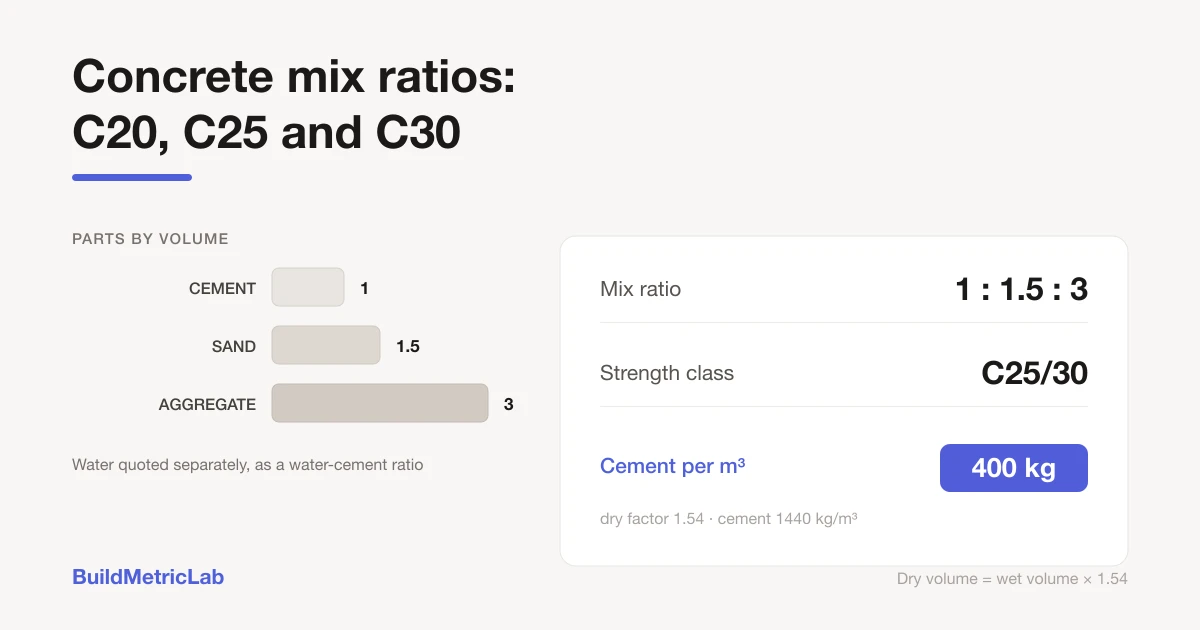
Take the workshop base from the opening — 4.2 m by 3.0 m (13.8 ft by 9.8 ft), 125 mm (4.9 in) thick — batched at 1:1.5:3, the nominal proportion most often quoted for general-purpose concrete in the C20 to C25 range, with a water-cement ratio of 0.55.
Finished volume is 4.2 × 3.0 × 0.125 = 1.575 m³ (55.6 cu ft, 2.06 cu yd). A 7.5% wastage allowance lifts that to 1.69 m³ (59.8 cu ft, 2.21 cu yd). Multiply by the 1.54 dry volume factor and you need 2.61 m³ (92.1 cu ft) of loose dry material.
The parts sum to 5.5, so cement takes 1/5.5 of that, sand 1.5/5.5 and stone 3/5.5 — giving 0.474 m³ of cement, 0.711 m³ of sand and 1.422 m³ of coarse aggregate. Bulk densities turn those volumes into something a merchant can price:
- Cement — 0.474 m³ × 1,440 kg/m³ = 683 kg (1,505 lb), which is 28 bags of 25 kg (55 lb), or 14 bags of 50 kg (110 lb)
- Sharp sand — 0.711 m³ × 1,600 kg/m³ = 1,138 kg, or 1.14 tonne (1.25 US ton)
- Coarse aggregate — 1.422 m³ × 1,500 kg/m³ = 2,133 kg, or 2.13 tonne (2.35 US ton)
- Water — 0.55 × the cement mass = 375 litres (99 US gallons), less whatever moisture the sand already carries
Nothing is rounded until the end, and the bag count rounds up — 27.3 bags isn't a quantity anyone sells. Divide the cement mass by the 1.69 m³ actually being batched and it comes out near 400 kg per cubic metre, which is where a 1:1.5:3 mix should land. If your figure comes out at half that, something in the chain has gone missing. A cement bags calculator repeats the last step for bag sizes from 20 kg to 50 kg (44 lb to 110 lb), which is worth doing because bag sizes differ by market.
How to use the concrete mix ratio calculator
The concrete mix ratio calculator takes element dimensions in metres or millimetres, a wastage percentage, either a target strength class or an explicit ratio, and the bag size you can actually buy. Imperial inputs convert on entry, so feet and inches return the same answer as metres.
The output lists the dry volume, the volume and mass of each constituent, a rounded bag count and a water allowance. The water figure is a ceiling rather than a target — aggregate moisture supplies part of it, and on a damp day it supplies a surprising amount.
If you're starting from a shape rather than a volume, the concrete slab calculator handles the geometry first, including falls and thickened edges, and its volume feeds straight into the ratio step. Our guide to how much concrete you need covers footings, L-shapes and circular pads if the element isn't a plain rectangle.
Common scenarios
A garden or garage base
Bases carrying a shed, workshop or garage floor are commonly batched around C20 to C25 — near 1:2:4 or 1:1.5:3 — at 100 mm to 150 mm (3.9 in to 5.9 in) over a compacted granular layer. The ratio is rarely what limits these slabs. Compaction of the sub-base and curing in the first week usually matter more, and neither shows up in the arithmetic.
Fence and gate posts
Post holes take small, awkward volumes, so many people reach for a fast-setting post mix instead — sold as postcrete in some markets and post-set concrete in others. Where posts go into site-batched concrete, 1:2:4 is typical, and the volume per hole is the hole volume minus the buried section of the post. Multiply by the number of posts before ordering, since the per-hole figure looks trivially small and the total rarely is.
A driveway or hardstanding
Vehicle loading and weather exposure push these toward C30 or above, with a tighter water-cement ratio, and air entrainment where freeze-thaw applies. Terminology diverges again at the surface: the wearing course over such a base is tarmac in some markets, asphalt or blacktop in others.
Repairs and small patches
For volumes under about 0.1 m³ (3.5 cu ft), the proportions matter less than consistency between batches. Mixing two buckets to slightly different recipes leaves a visible colour line and a plane of weakness where they meet. One batch, or a bagged pre-mix, avoids both.
Common mistakes
- Skipping the dry volume factor — ordering 1.69 m³ of dry materials for 1.69 m³ of concrete leaves the job about 35% short. It's the most expensive omission on this list, because you find out mid-pour.
- Ignoring sand bulking — damp sand measured by bucket can occupy 20% to 30% more volume than its dry mass suggests, quietly leaning out every batch. A water-cement ratio calculator helps here, since that moisture counts toward the water total too.
- Mixing unit systems — entering thickness in inches alongside plan dimensions in metres puts an order out by an order of magnitude, and the result looks plausible enough to act on.
- Adding water for workability — extra water improves placement and reduces strength in the same motion. Plasticisers address workability without moving the water-cement ratio.
- Assuming a nominal ratio delivers its class — volumetric proportions are a starting point. Reaching a specified strength reliably takes a designed mix, controlled batching and proper curing.
Sources and methodology
The volumetric method used here follows standard practice: finished volume, wastage allowance, dry volume factor, proportional split, then conversion to mass by bulk density. Bulk densities are conventional handbook values, and deliveries vary with source, grading and moisture content.
Strength classes and exposure classes are defined in standards rather than by any supplier, and the definitions are regional. EN 206 and its national annexes cover Europe and the UK; ACI 318 and the ASTM material standards cover North America; IS 456 covers India; AS 3600 covers Australia. Each sets its own minimum cement contents and maximum water-cement ratios per exposure class, so the class that satisfies one code isn't automatically the equivalent under another.
- The Concrete Centre — concrete specification and strength classes, covering the EN 206 framework
- American Concrete Institute — ACI 318 and related guidance, for the psi-based cylinder convention
- BRE — building research and materials guidance, on mix design methodology and durability
Putting it together
The proportions are the easy part. What separates a clean order from a pour that stops halfway is the sequence around them — net volume, then wastage, then the dry volume factor, and only then the split into cement, sand and stone. Get that order right and the class chosen on paper has a fair chance of being the one that ends up on site. Get it wrong and no ratio saves you. Run the numbers through the concrete mix ratio calculator before ordering, keep the net and ordered figures side by side so the margin stays visible, and confirm the specification against the code that applies where you're building.
Frequently asked questions
What is the correct mix ratio for C25 concrete?
There isn't a single correct answer, which is why quoted ratios differ so widely. Nominal proportions of 1:1.5:3 and 1:1:2 are both commonly cited for concrete in the C20 to C25 range, and the difference between them is substantial — roughly 400 kg versus 550 kg of cement per cubic metre. Codes recognise this: IS 456 permits nominal volumetric mixes only up to M20, while EN 206 separates designed, prescribed and standardised prescribed concrete, with the standardised prescribed route confined to lower classes. Site batching is far less consistent than a plant, so a nominal proportion is a starting point rather than a promise of strength. Structural elements normally follow a designed mix specified by mass.
How many bags of cement per cubic metre of concrete?
For a 1:1.5:3 mix, roughly 400 kg of cement per cubic metre (35.3 cu ft) of concrete produced — about 16 bags of 25 kg (55 lb), or 8 bags of 50 kg (110 lb). Wastage raises the volume you batch, not the rate per cubic metre. Leaner concrete mix proportions such as 1:2:4 fall to around 317 kg, near 13 bags of 25 kg, while a richer 1:1:2 climbs to about 554 kg, or 22 bags. Those figures assume a cement bulk density of 1,440 kg/m³ and a dry volume factor of 1.54, so check which bag size a quoted figure refers to before comparing — the 25 kg and 50 kg counts differ by a factor of two.
What is the difference between C20, C25 and C30 concrete?
The number states characteristic compressive strength in MPa at 28 days, so C30 is stronger than C25, which is stronger than C20. The gap comes from cement content and water-cement ratio rather than anything exotic. C20 is generally used for non-structural work — bedding, blinding, light garden bases. C25 covers general-purpose slabs, footings and paths. C30 and above turn up in driveways and anywhere exposed to freeze-thaw cycles or vehicle loading. Exposure class matters as much as load, because a porous mix in a wet climate degrades long before anything overloads it.
Should concrete be batched by volume or by weight?
Batching by mass is more accurate, because sand carries moisture that inflates its apparent volume — an effect known as bulking. Damp sand can occupy 20% to 30% more space than the same mass when dry, which leans out the mix wherever buckets are used without adjustment. Volumetric batching stays common on small jobs because it needs no scales, and it performs acceptably for non-structural elements where a strength margin absorbs the error. For structural concrete, weigh-batching or a ready-mixed supply is the normal route, and in many jurisdictions it's what the code requires.