· Timber & Framing
Board Feet and Timber Volume Explained
A board foot is a unit of volume, not of length, and a cubic metre holds 423.8 of them. The formulas both ways, a worked example in metric with imperial equivalents, and the nominal-versus-finished distinction that inflates most timber tallies by about half.
An internal stud partition 4.8 m (15.75 ft) long takes a little under 0.2 m³ (7 cu ft) of softwood. That is about 81 board feet, before a single offcut. Ask a supplier who quotes nominal sizes for the same wall, though, and the tally can come back half as high again for exactly the same wood. Which number is right depends entirely on which convention you are standing in, and a timber and board feet calculator settles it.
What is board feet and timber volume?
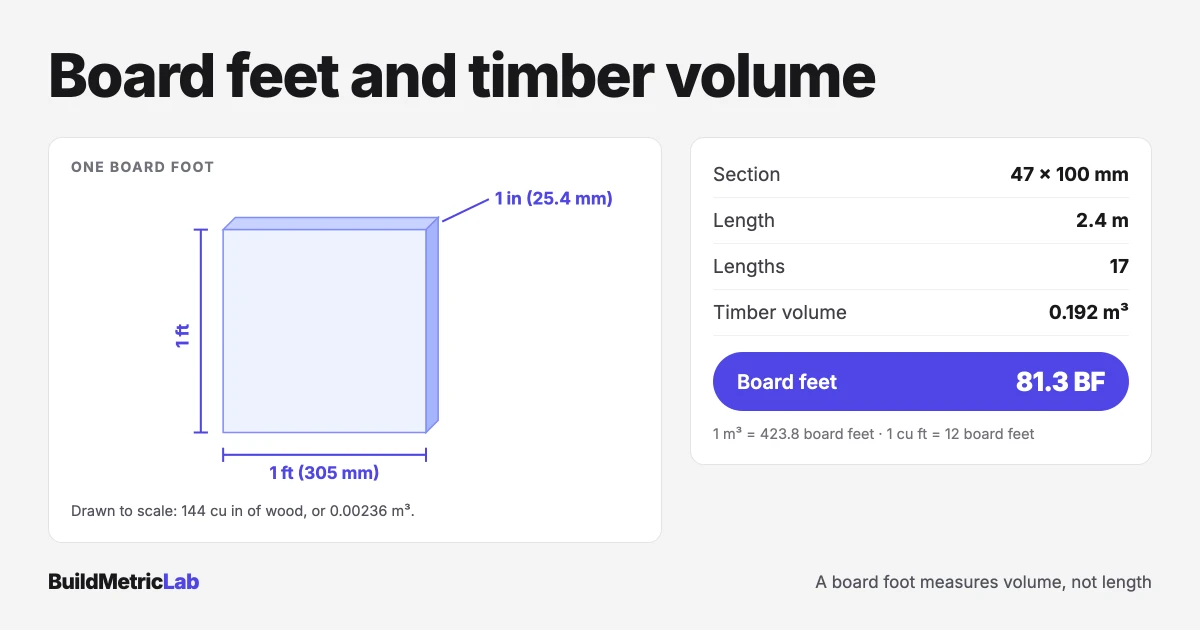
A board foot is a unit of volume. Not area, not length: volume. It measures a piece of wood 1 ft long, 1 ft wide and 1 in thick, which comes to 144 cubic inches, or 0.00236 m³ (2.36 litres, 0.62 US gallons). Any shape holding that much wood counts as one board foot, so a long thin batten and a short fat plank can tally the same.
Timber volume is that same quantity in cubic metres, which is how most of the world buys and ships wood. One physical thing, two units. Board feet dominate in the United States and Canada, Australia and New Zealand call the identical unit a super foot, and everywhere else the cubic metre does the work. The pile in the yard does not change, whatever the yard calls it: timber across the UK, Ireland, Australia, New Zealand and South Africa, lumber in the United States and Canada.
Why board feet and timber volume matters
Volume is what a sawmill sells and what a haulier charges for. Length on its own cannot price an order, because a linear metre of a heavy section and a linear metre of a light one are not the same purchase. Two deliveries of identical linear length can differ threefold in volume.
Volume also predicts weight, and weight decides how the material reaches site. Kiln-dried softwood typically sits around 500 kg/m³ (31 lb/cu ft), so a cubic metre lands as roughly half a tonne (0.55 US tons). Green oak can approach double that, and it will not stay the size it arrived at, because timber gives up volume as it dries. A section measured green is not the section you fix months later. Work the volume out first and you know whether the delivery is a van job or a crane job.
Hardwood forces the issue. Boards arrive in random widths rather than fixed sections, so counting them by the piece tells you almost nothing about what you are buying. The trade tallies them by volume instead, board by board, and the board foot is the unit that tally is kept in.
How board feet and timber volume is calculated
Volume is three dimensions multiplied together. The only real work is keeping the units straight.
In metric, convert the section from millimetres to metres, multiply by the length in metres, then multiply by the number of pieces. Cubic metres come out the other end with no conversion step at all.
Imperial carries a divisor, because the thickness is quoted in inches while the length is quoted in feet. Multiply thickness in inches by width in inches by length in feet, then divide by twelve. Measuring that length in inches instead? Divide by 144.
Moving between the two systems is a single multiplication, because a board foot is a fixed volume rather than a ratio.
Metric volume:    V  = (t / 1000) x (w / 1000) x L x n

Board feet:       BF = (T x W x Lf) / 12
                  BF = (T x W x Li) / 144

Conversion:       BF = V x 423.776
                  V  = BF x 0.0023597

Total length:     Ltot = L x n
Order quantity:   N  = ceil( n x (1 + waste) )
Where:
- t = section thickness, mm (in)
- w = section width, mm (in)
- L = length of one piece, m (ft)
- n = number of pieces, dimensionless
- V = timber volume, m³ (cu ft)
- T, W = thickness and width in inches
- Lf, Li = length in feet, or in inches
- BF = board feet, a volume tally
- waste = wastage allowance, dimensionless
- N = whole pieces to order, dimensionless
A worked example
Take a stud partition 4.8 m (15.75 ft) long and 2.4 m (7.87 ft) floor to ceiling, framed in 47 × 100 mm (1.85 × 3.94 in) softwood at 400 mm (15.75 in) centres. Worth flagging before the arithmetic: 400 mm and the 16 in centres used across North America are close but not the same spacing, so a frame set out in one convention will not carry the piece count of the other. Everything below is bought in 2.4 m lengths.
Step 1, count the pieces. 4,800 ÷ 400 = 12 spacings, so 13 studs. The head and sole plates, called top and bottom plates in North America and Australia, run the full length twice over, 9.6 m (31.5 ft), which is another 4 lengths. That gives n = 17.
Step 2, volume of one length. 0.047 × 0.100 × 2.4 = 0.01128 m³ (0.398 cu ft).
Step 3, total volume. 17 × 0.01128 = 0.19176 m³ (6.77 cu ft).
Step 4, board feet. 0.19176 × 423.776 = 81.26 BF.
Step 4a, check it the imperial way. The same stud in inches is 1.8504 × 3.9370, and 2.4 m is 7.874 ft. (1.8504 × 3.9370 × 7.874) ÷ 12 = 4.780 BF per length. Seventeen of those give 81.26 BF. Both routes agree, which is the whole point of running both.
One thing trips up anyone checking that figure against the wall itself. What is tallied above is the timber bought, not the timber left standing. Studs sit between the plates, so a 2.4 m ceiling needs studs cut to 2,306 mm, each leaving a 94 mm offcut. You pay for the full 2.4 m either way, which is why the order is priced on stock lengths and not on cut lengths.
Step 5, wastage. Timber gets cut to length and the ends are rarely reusable, so 10% is a sensible starting point on a wall this simple. N = ceil(17 × 1.10) = ceil(18.7) = 19 lengths.
Step 6, the order. Nineteen lengths is 45.6 m (149.6 ft), 0.214 m³ (7.57 cu ft), or 90.8 board feet. At 500 kg/m³ that comes to roughly 107 kg (236 lb). Not a one-trip carry.
Rounding only at the end matters here. Round the per-length volume to three decimal places first, to a tidy-looking 0.011 m³, and seventeen of them tally 79.2 BF rather than 81.3. Two board feet adrift on one partition wall, and short rather than long. On a whole-house frame that kind of error compounds quietly.
A joiner would query one thing about the example, and rightly. Nobody buys 2.4 m plates for a 4.8 m wall when 4.8 m stock is on the shelf, because two 2.4 m pieces per plate put a joint mid-wall for no reason at all. Holding everything at a single length keeps the arithmetic legible, and it matches the way the calculator works, one section and one length per run. Real orders get split into several runs.
How to use the board feet calculator
The board feet calculator takes four dimensions and one optional rate. Length is the length of a single piece in metres, not the running total. Width and thickness are the section in millimetres, and swapping them makes no difference to the answer. Quantity is the number of pieces at that section and that length.
The result panel leads with timber volume, in cubic metres on the metric setting and cubic yards on the imperial one. It then repeats the section back, gives the total linear length, an approximate board foot tally, and an estimated cost if a price per metre has been entered. The worked example above reports as 0.192 m³ in metric and 0.251 cu yd in imperial, and the board foot tally reads 81.3 either way. That price field takes whatever local currency and local rate apply, before any local sales tax or VAT.
The board foot figure is derived from the actual section you type, so it reflects finished timber rather than a nominal tally. A mixed order runs once per section: studs at one size, plates at another, noggins at a third, with the volumes added at the end. Noggins go by blocking in North America and dwangs in New Zealand and parts of Scotland, and they are the piece most often left out of a first estimate.
Common scenarios
Framing a garden shed
A shed frame mixes several sections in one job, and the volumes are small enough that the delivery decision usually turns on total weight rather than piece count. Sizing the frame comes first. The shed timber calculator works studs, plates and sheet material out from the shed footprint, and those piece counts feed straight into a volume tally for the whole build.
Ordering hardwood by the board foot
Rough-sawn hardwood is quoted in quarters of an inch: 4/4 is one inch, 5/4 an inch and a quarter, 8/4 two inches. A 4/4 board 190.5 mm (7.5 in) wide and 3.05 m (10 ft) long tallies (1 × 7.5 × 10) ÷ 12 = 6.25 BF, or 0.0147 m³. That tally is taken at the rough thickness, before surfacing. Plane the same board down to the 20.6 mm (13/16 in) that NHLA rules treat as standard for surfaced 4/4 and it is still sold, and priced, as 4/4. You pay for the sawdust.
Working out a decking order
Decking is bought by the board rather than by volume, but volume still answers the delivery question. A 144 × 28 mm (5.67 × 1.10 in) board 3.6 m (11.81 ft) long holds 0.0145 m³, or 6.15 BF. So a 47-board order comes to 0.68 m³ (24 cu ft) and around 340 kg (750 lb), which is a pallet and a forklift rather than a roof rack. Board counts come from the decking board calculator, which handles the gap between boards and the cutting waste.
Reconciling a quote across markets
A mill quoting in board feet and a merchant quoting in cubic metres can be compared directly once both sit in the same unit, using the conversion above. Do one check before that, though: confirm the two quotes describe the same finished section. That is where they usually diverge, and no amount of unit conversion reconciles two different pieces of wood.
Common mistakes
- Tallying nominal size instead of actual. This is the big one. A piece sold as a 2 × 4 in North America measures 1.5 × 3.5 in once dressed. Tallied nominally, an 8 ft length reads (2 × 4 × 8) ÷ 12 = 5.33 BF. The wood actually present is (1.5 × 3.5 × 8) ÷ 12 = 3.5 BF, so the nominal figure overstates the timber by about 52%. Sections described as CLS or regularised in the UK, S4S or dressed in North America, and DAR in Australia and New Zealand have all been planed, which makes the finished dimension the one to work from. Measure a piece off the actual delivery rather than trusting a catalogue. Mills drift, and air-dried or riven stock drifts further.
- Confusing a board foot with a linear or square foot. A linear foot measures length. A square foot measures area. A board foot measures volume, so it cannot be read off a tape without three dimensions in hand.
- Mixing metric and imperial mid-calculation. A section quoted in millimetres against a length quoted in feet will not reconcile. Convert once, at the start, then stay in one system through to the final figure.
- Treating log scale as board feet of sawn timber. Standing trees and round logs are measured by log rules that estimate recoverable yield rather than actual volume. A log scaled at 200 BF will not cut exactly 200 BF of boards, and the difference swings either way depending on log diameter and which rule was used.
- Leaving out wastage. Cutting to length, docking for defects, offcuts at the end of a run: none of it appears in the geometry, all of it comes out of the pile. Allowances of 5 to 10% suit straightforward work. Selecting for appearance, or working from a varied cutting list, eats considerably more than that.
Sources and methodology
The relationships here are definitional rather than empirical. A board foot is fixed at 144 cubic inches, an inch is fixed at exactly 25.4 mm, and every conversion above follows from those two facts. Each figure in the worked example and the scenarios was computed from first principles and is reproducible from the formulas given. The worked example assumes a 10% wastage allowance and rounding up to whole lengths, so where the calculator applies a different default its total will differ by that margin.
Conversion factors between roundwood, sawnwood and the units each is traded in are published jointly by FAO, ITTO and UNECE, which makes them about as market-neutral as this subject gets. For the material properties that decide what a given volume weighs and how it behaves as it dries, the Forest Products Laboratory's Wood Handbook is the standard engineering reference. It is published in the United States, though its density and moisture data get used a long way beyond it.
Terminology for round and sawn timber, dimensions included, is standardised internationally in ISO 24294. That one is worth knowing by number rather than by link, because the text sits behind a paywall. Check the equivalent reference for your own region, and treat the supplier's stated finished section as the governing figure for any tally.
- FAO, ITTO and UNECE: Forest product conversion factors
- Forest Products Laboratory: Wood Handbook, wood as an engineering material (FPL-GTR-282)
Putting it together
Board feet and cubic metres are two ways of writing the same number, and moving between them is one multiplication once the finished section is known. The work that actually protects an order happens before that: establishing whether a quoted size is nominal or finished, keeping every dimension in one system, and rounding only at the last step.
Get those three right and volume becomes the reliable figure it ought to be. It prices the order, predicts the weight, tells you how the material arrives, and lets a quote in one unit be checked against a quote in another. The timber volume calculator carries the arithmetic. The judgement about which section you are actually being sold stays with you.
Frequently asked questions
How many board feet are in a cubic metre?
A cubic metre holds 423.776 board feet. That figure is exact rather than approximate, because both units are defined: a board foot is 144 cubic inches and an inch is exactly 25.4 mm, which puts one board foot at 0.0023597 m³. Divide one by the other and 423.776 falls out. Two related figures are worth carrying alongside it. A cubic foot contains exactly 12 board feet, and a cubic metre contains 35.3147 cubic feet. For quick checks in the yard, 424 board feet to the cubic metre is close enough; the rounding error is under 0.06%, far smaller than the gap between a nominal and a finished section.
Do I use nominal or actual size to work out board feet?
It depends what the number is for. North American softwood is traditionally tallied at nominal size, so a piece sold as a 2 × 4 is counted as two inches by four even though it measures 1.5 × 3.5 in once dressed. That convention inflates the tally by about 52% against the wood actually present. For pricing against a mill quote, use whatever basis the quote uses, and say which one it is. For weight, volume, delivery planning, or comparison against a price per cubic metre, use the finished section, because that is the wood being lifted and fixed. Mixing the two bases is where most ordering errors start.
Is a board foot the same as a linear foot?
No, they measure different things. A linear foot, sometimes called a running foot, measures length alone and says nothing about the section. A square foot measures area across two dimensions. A board foot measures volume across all three: one foot long, one foot wide, one inch thick. Timber is commonly priced per linear metre or per linear foot for a fixed section, because within that section the two are proportional. Change the section and they part company immediately. A piece 50 mm thick contains twice the volume of a piece 25 mm thick over the same length, so a linear figure on its own cannot price it.
How do I convert board feet to cubic metres?
Multiply the board foot tally by 0.0023597 to reach cubic metres, or divide by 423.776, which gives the same answer. Going the other way, multiply cubic metres by 423.776. A tally of 500 board feet is 1.18 m³, and a cubic metre pack of framing timber tallies about 424 board feet. Two cautions apply. Both figures have to describe the same section basis, so reduce a nominal tally to finished dimensions before converting. And neither unit accounts for wastage, so apply the cutting allowance after converting rather than before, rounding to whole pieces only at the final step.