· Bathroom
Bathroom Renovation Cost Guide & Calculator
How a bathroom renovation cost is built up from area, specification and contingency, with a fully worked example and the pricing mistakes that throw budgets off. Includes a free calculator.
A small 5 m² (about 54 sq ft) bathroom can vary in price by a factor of two or three once labour, fixtures and tiling are added up. Same room, same footprint, and a price gap wide enough to fund a small kitchen. That spread is not random. It tracks three things anyone can pin down before a single tile is ordered: the floor area, the specification chosen, and the contingency held back for whatever turns up behind the old wall lining.
This guide breaks a bathroom renovation cost into those three parts so the headline number stops feeling like guesswork. Homeowners get a way to sanity-check a builder's quote. Trades get a quicker route to a defensible ballpark before the detailed take-off. The figures here are illustrative and given in proportions rather than any one currency; it's the method that's worth keeping.
What a bathroom renovation cost estimate actually covers
A bathroom renovation cost is the total spend to strip out an existing bathroom and replace it with a working, finished one. It bundles several separate trades into a single figure: strip-out and disposal, plumbing first and second fix, electrics, plastering, waterproofing, tiling, and the fixtures themselves.
The fixtures, meaning the bath, basin, WC, shower and taps, are the part most people picture first. They are rarely the biggest line, though. Labour usually is. A realistic estimate treats the room as a sequence of trade visits, each with its own day rate, materials and wastage allowance.
Wastage matters more here than in many rooms. Tiles get cut around pipes, niches and the inevitable awkward corner, so a slice of every order ends up in the skip. A good estimate accounts for that loss instead of pretending every square metre bought reaches a wall.
Why it matters for bathroom work
Bathrooms pack a lot of cost into a small footprint. A 4 to 6 m² (roughly 43 to 65 sq ft) room can carry as many separate trades as a far larger living space, which is why the per-square-metre (per-square-foot) figure looks alarming next to other rooms. Underestimating is common precisely because the area feels modest.
The wider market doesn't help. Construction labour and materials prices have shown sustained volatility in many countries in recent years, so a quote built on last year's rates can drift quickly. Anyone estimating today is working against moving prices for both labour and materials.
There's a compliance angle too. Electrical work in a bathroom is treated as a special location in most national wiring codes (in the UK, under Part P of the Building Regulations; the widely adopted international reference is IEC 60364-7-701), and notifiable work has to be signed off appropriately. That's a decision for a qualified electrician working to your local code, not something a cost estimate settles. It still belongs in the budget, though, because certification and notification carry their own cost and time.
So a structured estimate does two jobs. It gives a defensible total, and it surfaces the line items that are easy to forget until the invoice lands.
How the calculation works
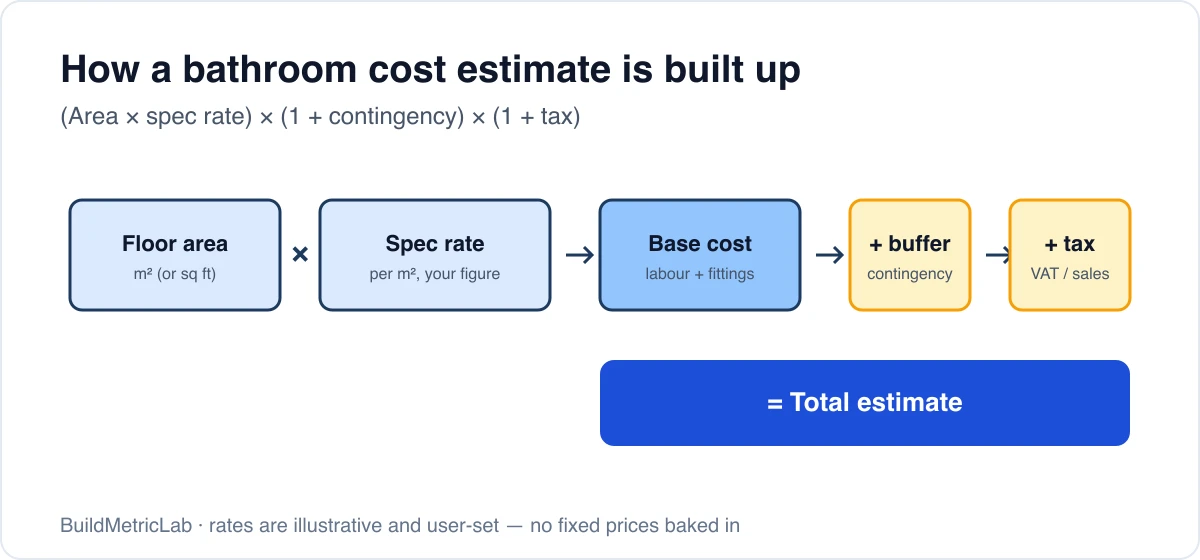
The calculator builds the total from the bottom up. It takes the floor area, applies a per-square-metre rate that reflects the chosen specification tier, then adds a contingency percentage on top of the subtotal. In plain terms: a base build-up scaled by how much room you have and how much you intend to spend per square metre, with a buffer for the unknowns.
Total estimate = (Area × Spec rate per m²) × (1 + Contingency / 100) × (1 + Local tax / 100)Where:
- Area is the bathroom floor area in square metres (m²), or square feet (sq ft) if you convert first
- Spec rate per m² is an illustrative all-in rate, in your local currency, covering labour, fixtures, tiling and finishes for the selected tier (budget, mid or high)
- Contingency is a percentage buffer for surprises found once work begins, added to the subtotal
- Local tax is any sales tax or VAT applied on top, entered at your local rate; set it to 0 for tax-exclusive trade prices or work that is zero-rated where you are
The per-square-metre rate does the heavy lifting. It isn't a single material price; it's a blended all-in figure covering labour, materials, plant and the contractor's margin. Because it's illustrative, the calculator lets you override it to match a real supplier quote, which is the point at which a rough estimate turns into a working budget.
A worked example with real numbers
Priya is renovating a family bathroom in a 1990s house. The room measures 5 m² (about 54 sq ft). She wants a mid-specification finish, decent but not luxury, and she keeps the default 10% contingency because the house is over 30 years old and she's expecting tired pipework.
Because prices vary by country and by year, it's clearer to work in proportions than in a fixed figure. Call the mid-spec all-in rate R per square metre in your local currency, an amount covering strip-out, plumbing, tiling, fixtures and labour. Before any local sales tax or VAT, the steps run as follows:
- Step 1, base subtotal: 5 m² × R = 5R
- Step 2, apply 10% contingency: 5R × 1.10 = 5.5R
- Step 3, add any local sales tax or VAT: 5.5R × (1 + tax rate)
On these inputs, the bathroom renovation cost calculator builds a pre-tax total of 5.5R, of which the contingency buffer (0.5R) is a little under a tenth of the total. That buffer isn't waste; it's the part Priya is hoping to hand back at the end of the job.
Two things keep the figure honest. The rate is an all-in build cost, not just materials, so it captures where the money actually goes. And the contingency sits on the full subtotal, so it scales with the job rather than being a flat token amount. Results vary by site conditions, of course. A hidden leak or a re-route of the soil stack can push the real number well past the buffer.
What each specification tier covers
Most of the difference between one quote and another comes from the specification tier, not the room size. The table sketches what each tier typically includes; the per-square-metre rate you enter should reflect the tier you actually choose.
| Tier | Typical scope | Where the money goes |
|---|---|---|
| Budget | Like-for-like swap, standard suite, part-tiled walls | Mostly labour and basic fittings |
| Mid | Same layout, mid-range suite, fully tiled walls, thermostatic shower | Balanced across fittings, tiling and labour |
| High | Reconfigured layout, premium suite, large-format or natural tiling, underfloor heating | Premium fittings and specialist labour |
How to use the bathroom renovation cost calculator
The tool takes three inputs and returns a single illustrative total. Enter the bathroom area in square metres (the default is 5 m², about 54 sq ft, which suits a small family bathroom). Pick a specification tier, budget, mid or high, to set the blended per-square-metre rate. Then set a contingency percentage; 10% is the default, and older properties often warrant more.
The output is an estimated cost, not a fixed quote. The prices are illustrative, so the most useful next step is to override them with figures from your own supplier or merchant in your local currency. A trade user pricing a job can drop in their day rate and materials cost; a homeowner can match a builder's quoted line items.
Try the bathroom renovation cost calculator with your own room measurements, then refine the spec rate once you've got a real quote in hand. The closer the inputs sit to your actual supplier prices, the more the estimate behaves like a budget rather than a guess.
Common scenarios
Like-for-like swap in a rental
A landlord replacing a tired suite without moving any plumbing keeps the cost low. The strip-out is clean, the layout stays put, and a budget specification on a 4 to 5 m² (43 to 54 sq ft) room holds the rate near the bottom of the range. A modest contingency suits this kind of work, since leaving the layout alone removes most of the surprise risk.
Full reconfiguration in a period property
Moving the WC, re-routing the soil stack and re-plastering damp walls pushes a period-property bathroom towards the high end. Older properties hide more, so a larger contingency, 15% or above, reflects the genuine uncertainty. The bathroom renovation cost calculator lets you raise the contingency input to model exactly that risk.
Trade pricing a quick turnaround
A fitter pricing several bathrooms a month can use the estimate as a first-pass figure, then firm it up with a proper take-off. Pairing the cost estimate with a bathroom tile calculator for the tiling allowance gives a faster, more defensible quote than eyeballing it.
Common mistakes
- Forgetting that labour dominates the total. Fixtures catch the eye, but trade days usually outweigh the suite. An estimate that fixates on the bath price misses where the money actually goes.
- Setting contingency too low on an old property. A 10% buffer on an early-1900s house often proves thin once the walls are opened up. Matching the buffer to the building's age is more realistic.
- Ignoring wastage on tiles. Cuts around pipes and niches mean ordering only the exact wall area leaves you short. A separate bathroom tile calculator handles that allowance properly.
- Omitting waterproofing. Wet-area tanking is easy to leave out of a mental budget yet essential behind showers. The waterproofing membrane calculator sizes that material.
- Treating the estimate as a quote. An illustrative figure built on default rates is a starting point, not a contract price. Reconciling it against a real supplier quote closes the gap.
Related calculations and tools
A bathroom renovation rarely sits on its own. These tools cover the quantities that feed into, or sit alongside, the overall cost:
- bathroom tile calculator works out tile quantities including a wastage allowance
- waterproofing membrane calculator sizes tanking for wet areas behind the shower
- WC clearance checker confirms the space around a relocated toilet
- kitchen worktop calculator is handy when a bathroom job runs alongside a kitchen refit
- kitchen cabinet count calculator helps plan storage units for a wider whole-home project
Sources and methodology
The estimate uses a blended per-square-metre approach scaled by specification tier and adjusted by a user-set contingency. The per-square-metre rates are illustrative all-in figures intended to be overridden with real supplier quotes in your local currency. The method was checked for internal consistency against the calculation shown in the worked example above.
The wider context and compliance points draw on:
- IEC 60364-7-701, Electrical installations — locations containing a bath or shower is the widely adopted international reference for wet-area electrical safety; most countries adopt or adapt it, so check your local code (in the UK, for example, it is applied via the wiring regulations and Approved Document P)
- RICS measurement and cost-estimating guidance for a structured, internationally recognised approach to building up construction costs
Compliance and specification decisions, including electrical safety, structural changes and ventilation, sit with the relevant qualified professional working to your local standards, not with a cost estimate.
The bottom line
A bathroom renovation cost is far more predictable once it's broken into area, specification and contingency, and the most reliable budgets come from feeding real supplier prices into a clear build-up rather than trusting a single headline figure. Running your own numbers through the bathroom renovation cost calculator and then refining the spec rate against an actual quote is the step that turns a rough idea into a budget you can defend.
Frequently asked questions
How long does a typical bathroom renovation take?
A straightforward like-for-like refit commonly runs around one to two weeks of trade time, depending on drying time for plaster and tile adhesive. A full reconfiguration that moves plumbing or involves re-plastering damp walls can stretch to three weeks or more. The timeline matters for budgeting because labour is charged by the day, so a longer programme directly raises the labour line. Sequencing adds dead time too, since tanking and tile adhesive need to cure before the next trade can start. Site conditions vary, so a qualified bathroom fitter is the right person to confirm a programme for a specific room.
Does the estimate include sales tax or VAT?
The calculator adds any local sales tax or VAT on top of the base cost and contingency. The field is editable, so set it to 0 if you're comparing against a tax-exclusive trade price or the work is zero-rated where you are. Tax treatment of renovation work varies widely by country, and sometimes by the type of work, so the definitive position comes from your local tax authority and a qualified accountant or your contractor.
How much should the fixtures alone cost?
Fixtures such as the bath, basin, WC, shower and taps usually make up a smaller share of the total than most people expect, often well under half. The balance goes on labour, tiling, plastering and waterproofing. A budget suite typically costs an order of magnitude less than high-specification fittings, which is largely what separates the calculator's spec tiers. Because the per-square-metre rate already blends fixtures with labour and finishes, isolating the suite cost is best done from your own supplier list. Adjust the calculator's spec tier up or down to reflect the fittings you actually plan to buy.
Why is my builder's quote higher than the estimate?
A real quote reflects access, the building's age, waste disposal, parking, and a contractor's overheads and profit, none of which a default per-square-metre rate captures perfectly. The estimate is illustrative and built on generic trade defaults, so a divergence is normal rather than a sign that either figure is wrong. Older or harder-to-access properties push real prices up. The most useful response is to override the calculator's spec rate with the figures from your quote, which turns the tool into a way to test where the quote's money is going. Results vary by site, so a qualified contractor's quote takes precedence over any illustrative number.